Tuesday, 30 June 2015

The Yellow-legs are coming

I managed to remain off patch for almost another 2 weeks - no wonder the year list has stalled! It doesn't look as though I've missed anything though, other than a Green Sand, a portent of the coming Autumn, which appeared last week for a day.

I spent some time yesterday and today in glorious weather checking out what's about.  One of the first birds I saw was a nice adult Yellow-legged Gull, which is the first of probably a few that come in in late summer every year.  This bird was still present this morning, as was another 2nd summer bird.  I took some distant record shots in strong light, so they are a bit washed out.

Adult 29th

Adult 30th


2nd summer 30th

It's always worth checking out the loafing flock of gulls that congregate daily on the spit, as even if there aren't any of the scarcer species amongst them, there will probably be a colour ring or two to read, plus it helps to gen up on the variability of Herrings and LBBG.  I ought to do a post on the colour ringed gulls that have been found here, as it always interests me to see how quickly gulls move through the site, where they have come from and also the site fidelity of certain individuals year on year that may have come hundreds of miles or more to get here.


This morning there were seven Little Egrets around, mostly on the spit; four adults, two home grown juveniles and a slightly older juvenile that had appeared from somewhere else.  Two eclipse male Shoveler and six Gadwall were the most interesting ducks.  When I arrived, there was a single Oystercatcher on the spit.  This was joined a short while later by another bird and they became quite vocal.  Later again and another pair arrived, one of which has a metal ring, all four birds then became very raucous and chased each other around before they all departed.  An adult Little Ringed Plover that I hadn't seen yesterday was on the west side of the spit.  All three juveniles that had been present a week ago and were probably home grown, have now departed.

The Common Terns are having a good season on the rafts.  I counted 15 juveniles and some of the raft is not viewable, so there are undoubtedly more.  I saw the first fledged bird fly to the spit this morning, though there are a few others that are swimming near the rafts and also perching on the overhanging branches of a nearby island.


A noisy family of Reed Warblers with at least two young and probably more are in the reed bed next to the western bench, so add some entertainment to the bench sitters.

Whilst not on patch last Monday 22nd, I did some dirty twitching.  I had been toying with the idea of going to see the Hudsonian Whimbrel at Pagham, but it didn't really inspire me.  However, when an adult Terek Sand turned up at the same location, a bird I haven't seen since 1988, I decided to make the trip and hopefully combine the two.  As it was mid week, I have to drop the kids off and pick them up from school, so this only gives about 2 hours at Pagham.  Fortunately, the Terek Sand was immediately on view, so I watched this for a while - a really cracking adult - and then began the search for the Whimbrel, which had apparently flown some distance toward Sidlesham earlier in the morning.  I spent the next hour and a half dipping, although found four Eurasian Whimbrel happily feeding on the mud.  One of these was being claimed by a large group of people as the Hudbrel, but was clearly not the bird.  After my allotted time was up, I had to leave.

I don't enjoy dipping, so now had more incentive to try again.  The bird seemed to be showing well on Saturday and Sunday morning, so I gave it another shot on Sunday afternoon, to coincide with a receding to low tide when the mud flats would be viewable.  This time, I scored as soon as I arrived, as the Hudbrel was feeding in full view out on the mud - clearly not the bird claimed on my previous visit!  It gave good scope views, but was never particularly close, maybe 100 yds at best.  My best record shot is below.


Along with the boldly patterned head and pale face/chin, the bird appeared a more rich brown colour than its Eurasian cousins, it also had a longer bill.  At one point, it stretched its wings into the air to reveal what is well described as cinnamon coloured underwing coverts, very different to the paler Eurasian colouring.  I watched it until it flew, when it revealed the lack of white in the rump, which was brown and fairly concolorous with the rest of the tail/mantle/wings.  So, although not inspired, at least it isn't on my dip list!

This leucistic Curlew was also mightily impressive.

Tuesday, 16 June 2015

It's been a while.....

June 15th - various factors have kept me off patch recently, but I was a bit surprised to see that this is my first post in 4 weeks.  I spent half term week in Ireland with the family and keep getting booked up when I might have been able to get on patch.  Still, local stalwart Alan S spends a lot of time here and it doesn't look like I've missed much - there was a long staying Greenshank in late May that stayed from the 27th to June 1st - I could have seen on my return fro Ireland, but I chose to twitch the smart female Red-necked Phalarope at Theale GP instead, a much better choice, plus I've had Greenshank on patch this year already.  My first visit after Ireland was the on the 2nd and was the day the bird chose to depart.  The worst miss is undoubtedly Cuckoo, with a single silent female seen flying over the lake on the 11th - this is the only sighting so far this year, so I'm in danger of missing this bird this year, which is a bit of a sad state of affairs.

On my few visits in June, there has been a small build up of unseasonal ducks.  Five Pochard were present for a day on the 2nd and a single male was seen on the 13th and 15th; two male Shoveler and a single male Teal were also present on the 13th, with the two Shoveler still there on the 15th.  Little Ringed Plovers have obviously bred successfully nearby, as two full grown juveniles appeared on the 12th and there were three on the 13th along with four adults.  Three juvs and three adults were seen on the 15th.  I saw my first Common Tern chick on the rafts on the 3rd and there are now lots! A bumper breeding season I hope.  The first two juvenile Black-headed Gulls appeared on the 12th, presumably from somewhere nearby, though not here, and were still around on the 15th.  Oystercatchers have been ever present in varying numbers from 1 to 3 or 4.  I assume that these are failed breeders, though it is possible that one pair is breeding somewhere locally, as there was only one bird present for a while which might have been the male of a pair - probably wishful thinking.  Shelduck have also been present throughout, usually a pair but sometimes two pairs.  The Little Egrets may be down to two nests now, though only two almost full grown young have been seen so far.

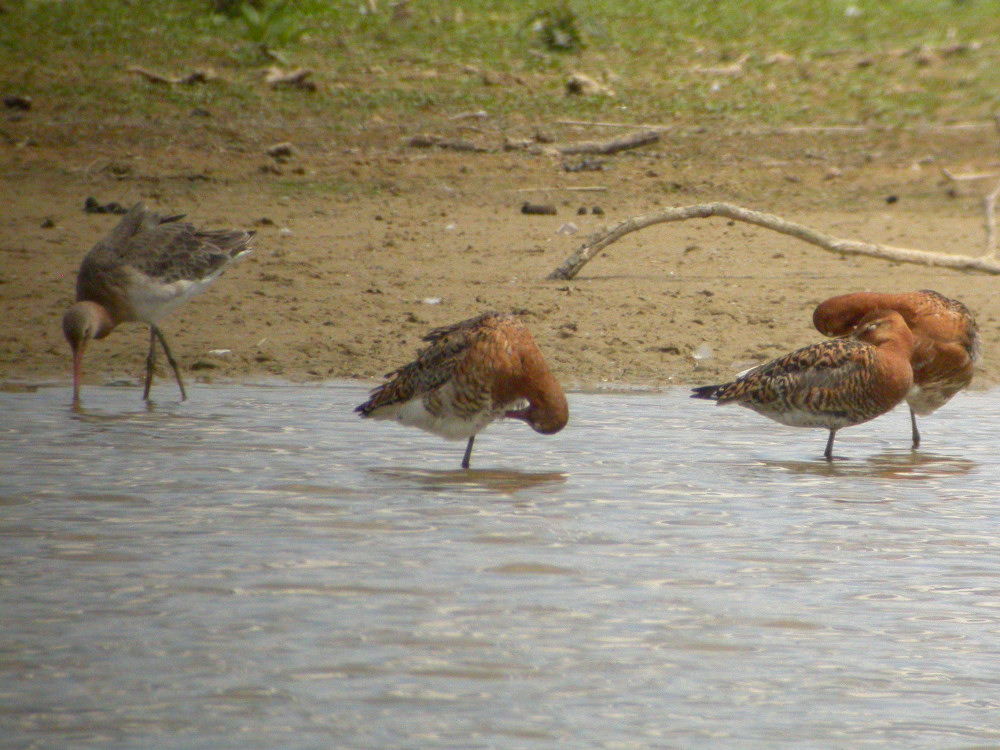
That sort of brings things up to date, which brings me on to today, the 15th.  Mike M dscovered four Black-tailed Godwits and a pair of Garganey early on - six good birds for mid June.  I had to wait until early afternoon to visit as my car was in the garage, but luckily all the birds were still present.  The Garganey spent most of the time asleep on the spit, the male beginning to moult out of his Spring finery, but all were on the west side, which meant that viewing was quite good.  The Blackwits consisted of three fine summer plumaged birds and a single in non-breeding plumage.  You can but speculate where these birds came from on this date, as it seems a bit early for returning breeders.  Maybe they failed or are non breeding wanderers.  Anyway, Garganey is a nice year tick and some record shots below:


Wednesday, 20 May 2015

Unseasonal Caspo

May 19th - the lake has been attracting about 20-30 LWHG most days recently.  Quite a few adult LBBG, which are presumably local breeders, but also many immature birds.  Today, a rather interesting and very bleached 2cy bird arrived late morning and immediately stood out as a contender for Caspian Gull.  I set about taking some record shots and trying to see all the required features.  Although the coverts were very worn, the inner GCs appeared to show nice broad pale tips and in some angles, the inner GCs appeared to show solid centres, but to be honest, there wasn't much left in the way of markings here.  What was left of the dark marks on the scaps looked good and the tertials looked to have remnants of pale tips, though these were quite worn and brown looking.  The head was nice and white with a dark streaked shawl, a small dark eye and a good looking long and narrow bill beginning to show some paleness at the base.  The legs were long, particularly the tibia and were a good shade of pale pink.  I was keen to see the underwing, particularly after last year's May contender, which looked quite good until it showed a dark brownish underwing.  This bird had a nice pale almost white looking underwing, so another box ticked.  Finally, the tail band looked good, despite being worn and brown and the upper tail was nice and white.  So, all in all, the features all pointed to Casp and I couldn't see anything to suggest hybrid, so a nice unseasonal find:


Monday, 18 May 2015

Ups and downs

Last Monday 11th, I had spent a couple of hours from 9am at the lake. It was sunny and settled and not a lot seemed to be happening, so at about 10:45am, I said farewell to regular Alan S and set off elsewhere in search of Nightingales.  At 11:45am, whilst at least half an hour away from the patch, I received a text from Alan to say that a Spoonbill had just landed!  I quickly made my way back, but had got the unwanted text en route - 'Spoonbill has flown off west'.  So I arrived back and the bird hadn't returned.  It had spent all of 8 minutes on the spit before being spooked by the terns and flying off and I had missed it by about 20 minutes - the joys of patch listing!!! I wonder whether it might be the adult bird from last year that was present on two separate days in May and one in July (assuming it was the same bird).  I spent the next couple of hours in a fruitless wait for a no return.

The following day a summer plumaged Dunlin arrived and was around for a couple of days and a Common Sand on the 12th became two on the 13th.  There has also been a pair of Oystercatchers that fly in and out quite a bit, though Alan discovered that there might actually be two pairs, as he saw four birds together later in the week.

An unseasonal pair of Shoveler turned up on the 13th, possibly failed breeders, and on the 14th a further male joined them.  The 14th was a wet day and a late visit after work found 8 adult Little Egrets standing in the west end of the heronry.  The first nest hatched three juveniles this week, so another breeding success for this species.

Yesterday, the 17th, I was pleased to receive a text from Alan to say that he had discovered an adult Little Gull on the pit.  I was travelling back from Aylesbury with my daughter and could not get straight over there and conscious of how quickly these birds can depart wanted to get there as quickly as I could.  Once back at home the dreaded text arrived - 'can't see the bird', so I thought I had missed another good bird, but luckily, shortly later it was back, so I headed straight down and within a few minutes was watching a glorious full summer adult Little Gull.  It was swimming at the end of the spit, so I grabbed some quick record shots before enjoying watching it further:


This is a surprisingly scarce bird here and is only my second record since one in April 2004, though there have been other birds that I've missed, so I was very pleased to catch up with this one.  I had also missed another one last month that had arrived and gone straight through shortly after I had left the site for work.  At one point, I watched it fly off from the pit, showing those beautiful dark underwings, and fly off down the river.  I assumed that it had gone, but ten minutes later it returned.  In fact, according to other observers, it did this several times during its stay and was maybe using the river to feed.  It was last seen just before 7pm gaining height over the island and flying off S/E.

So onto today, the 18th, another wet morning.  I arrived at about 8:50am after dropping the children at school when the rain was fairly light.  Two Common Sands were new in and two LRPs and a pair of Oystercatchers made up the wader count.  At c9:45am, I suddenly noticed an adult Kittiwake flying in towards the end of the spit - it had presumably come in off the river.  It touched down on the water just beyond the spit where I took some truly awful record shots (these birds always seem to arrive in dull and wet conditions when my digiscoping fails to focus on anything!).


It drifted beyond the spit and then after only about three minutes on site it took to the air and flew off west, maybe back to the river.  This is my second Kittiwake this Spring following a bird in April and another one in March last year, so three birds in just over a year is pretty good going for what is supposedly a rare bird on patch.  The rain then set in and lasted until late morning, but little else of note was seen other than a single Linnet that flew in and landed on the spit - not common here.

Sunday, 10 May 2015

A quiet spell

Not much seen during my last few visits, but highlights have been a couple of tundra Ringed Plover on the 7th and a 2nd summer Yellow-legged Gull on the 6th.

The gull was unexpected, as May is not generally a good month for these.  Its bare parts were particularly bright.


The Ringed Plovers were present all day on the 7th, but I wasn't able to get there until late in the day after work , so my record shot is particularly bad in poor light:


After a quick but fruitless visit yesterday morning, I decided to go and see the Greater Yellowlegs in Hampshire.  I was especially pleased to see this bird turn up again, as I had dipped it about 3 weeks ago.  A nice and confiding Bonaparte's Gull was also on offer in Southampton, so a pleasant afternoon all round:


Tuesday, 5 May 2015

Spot Fly

May 5th - today looked promising with rain moving through and strong winds, though they were mainly from the west, which is not a great direction, east is much better.  I spent the morning waiting for birds to turn up, but nothing really happened, due probably to the westerlies.

An Arctic Tern arrived mid morning and stayed for twenty minutes or so.  Alan S and I watched a Common Tern chase it on a couple of occasions, so maybe it didn't like it intruding on its territory.  At about 11am, all the terns and hirundines on site formed a big ball and we looked around for the Hobby, but were surprised to see an unseasonal Peregrine fly through, the Arctic never returned.

It was nice to see good numbers of hirundines and Swifts, 150-200 each of Swallow and Sand Martin, 50-100 House Martin and 100-150 Swifts.

I left Alan at midday to go and pick up a new lawnmower blade, after which I decided to check Pump Lane paddocks.  I spied a very orange looking bird distantly to the north, which instantly disappeared and it took a further 15 minutes to find it again - a nice female Greenland type Wheatear.  As I was leaving, a darting bird in front of me proved to be my second earliest Spotted Flycatcher - not an easy bird on patch, particularly in the Spring, so a nice surprise.  It was flycatching for a while and then spent some time sitting on a wire of a fence keeping out of the very windy conditions - I was able to take a poor record shot, but you can see what it is!  Alan had texted in the meantime that a Dunlin had arrived at the pit, but I didn't have the time to go and see it - I'm sure there will be others!

Another day, another wader!

May 4th - I didn't fancy an early morning today - not a good attitude for finding birds!  Anyway, we had semi-planned a family walk along the river before lunch.  So when the text arrived from Alan S saying that 2 Whimbrel were on the spit just before we were due to leave, it made the decision of where to start the walk much easier!

Whimbrel, along with Blackwits, are about the most regular of the scarce large waders on patch and most Springs will turn up a few birds.  So at about 11am, with a quick minor detour, I spent all of 30 seconds looking through Alan's scope at a nice pair of Whimbrel.  We continued on our walk, which was very nice in the warm sunshine - birds on note were a Yellow Wagtail flying off from the cattle field and a couple of singing Whitethroats.

On our way back to the car, I received another text from Alan saying that Jackie N had found a male Mandarin on the east side of the lake, but only viewable from the east side - this was unfortunate, as our walk did not take us this way, so that year tick would have to wait.

Fortunately, I had a spare hour late afternoon, so made my way down again.  I drove straight to the east side and within a few minutes was looking at a distant male Mandarin.  It is surprising how scarce these are on site, particularly as it is not too difficult to find them on the Thames nearby - I average about one sighting a year and usually of wandering males.  Suddenly, for some unknown reason, the Mandarin took off and flew towards the main island where I lost sight of it.  Then, the two Whimbrel revealed their continued presence by taking off and calling.  I watched them distantly as they flew around but then descended back to the spit.  I decided then to drive quickly back to the west side, as I wanted to take some record shots.  On arrival, the two birds were quite close on the near spit, so I grabbed some reasonable records.  They were calling fairly constantly and took off several times, but kept returning, but they were obviously looking to leave.  They were still there when I left at 4:30pm but were seen to fly off high north just 30 minutes later.  An added bonus was that the Mandarin had also flown to the near sand spit, so I was able to take some shots of him too!


I like this one - Mandarin shaking, tern looking skywards