Monday, 30 June 2014

Little Egrets breed

June 30th - there is an established heronry on the main island where Grey Herons and Cormorants have been breeding for years. Several times over the past few years, a Little Egret or two have visited the heronry during the Spring and there were hopes that they might breed.  However, this year up to 6 birds were present in early May and I was pleased to see a sitting bird hidden away in the canopy on May 10th - this nest became almost impossible to see later on as the foliage covered it over.  About a week later, a second nest and sitting bird was found at a slightly more visible location.  At least 2 small juveniles were seen at the second nest site on June 16th, which meant that the first nest probably had larger juveniles in it, though I could not see this nest.  During this time, up to 2 adult birds, presumably the males, were fishing around the lake on most days, though sometimes the male guarded the nest whilst the female went off to feed.  Kevin H saw juveniles in both nests on the 21st and by the 25th, juveniles from the first nest were large enough to be walking around the tree canopy and are now very visible.  Judging by their size and the amount of wing flapping going on, I expect the maiden flights to be any day.  This is only the 3rd confirmed nest site in the county and will hopefully be the start of a regular colony.

A record of the 3 large juveniles from the first nest seen this morning:


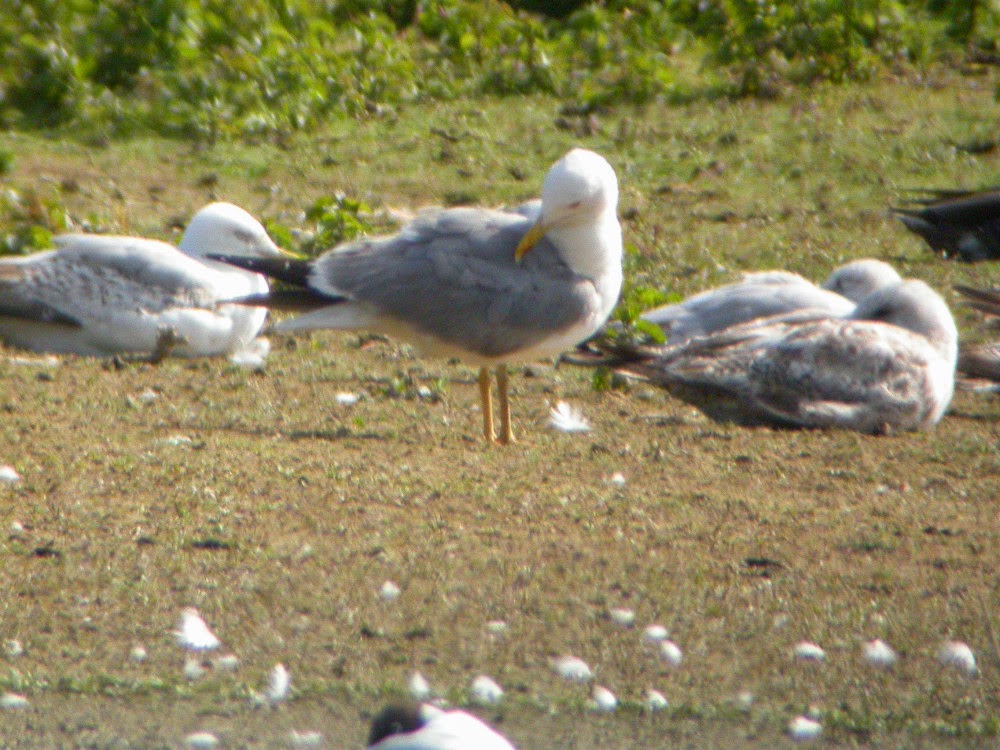
Also present this morning was a 3rd or 4th summer Yellow-legged Gull - it looked pretty much adult, but had remnants of black feathering in the primary coverts and tertials and the primary mirrors were small.  The legs were certainly a lot more yellow than last week's adult. This is the third YL Gull of the season, as a typically grotty 1st summer was also present for a couple of days last week.


An Oystercatcher, male Pochard and a couple of Teal were the other birds of note.

Monday, 23 June 2014

First tick in 6 weeks

23rd June - not much happens during the first half of June, hence my lack of updates.  However, today I got my first year tick since mid May.  It is a reflection on how relatively poor the Spring wader passage was at the site that today's Green Sandpiper is my first of the year.

Post breeding birds are beginning to build now, notably Lapwing of which there are regularly 100+ birds on the spit and gulls, both LWHG and BHG.  Today's adult Yellow-legged Gull is the same bird I saw last Friday (20th) and no doubt will be the first of a few during the regular post breeding influx.


A single Oystercatcher has been around most days since the 7th and adult Little Ringed Plovers fluctuate between 1 and 3 - I'm sure this number will increase and hopefully with some juveniles as well.

A few unseasonal ducks have appeared during the month.  Following the pair of Teal, which departed straight away, there has been a single one day male Pochard on the 9th, a single male Shoveler on the 11th, followed by a pair on the 16th and then 2 different males from the 19th, which are still there today.  The Shelduck seem to have finally given up the ghost, as I last saw the regular pair on the 16th, when there in fact 2 pairs present.


The Common Tern rafts have been fairly successful this year - I counted 13 small juveniles on the 13th and there is still much feeding of larger juveniles today, but counting them whilst they also shelter from the sun is not easy!

Plenty of evidence of other successful breeding as well, Great Crested Grebes, Coots, Moorhens, Mallards, Cormorants, Grey Herons amongst others and I saw some young Reed Warblers chasing around a NW reed bed last week.


Anyway, as predicted, today's adult Green Sandpiper and Yellow-legged Gull mark the start of Autumn, as birds begin to move back through - Summer only lasts a couple of weeks in birding!

Tuesday, 3 June 2014

I think it is.....(see last post)

June 3rd - it's all gone quiet.  This morning a pair of Teal had returned to the lake, the first of the returning birds and possibly failed breeders.  A male Cuckoo was singing from trees on the base of the spit and 2 LRPs were present.  These 2 were also here yesterday evening and look like 2 single birds as opposed to a pair as they are nearly always a long way apart.  The usual pair of Shelduck are still here, though no sign of any attempted breeding, apart from the occasional flight over the reed bed.

A few more LWHG are beginning to appear, mostly immatures, but also the odd adult.  Yesterday evening a 1st summer Common Gull also dropped in, which are pretty scarce this time of year.


On Saturday, one of the LBBG had a green ring with code K.BBK on it, which is a Dutch ringing scheme - I await further details of its history.  It shouldn't be too long before the YL Gulls start to appear.

Only another 2-3 weeks before the adult waders will be coming back through and Autumn migration will have started!

Monday, 26 May 2014

Is Spring over?

Despite there still being reports of various waders, notably Sanderling, not too far away, it feels like Spring passage has dried up.  I still live in hope of picking up something, but wader passage has been pretty poor this year, with just the occasional goodie thrown in.

Last Tuesday (20th) I had a nice male Yellow Wagtail on the spit, which is only my third of the year and the first on the deck - not good.  I also picked up a presumed passage wader in the form of a Redshank that flew in calling mid morning.  Early the following morning, a Common Sand was also possibly a new arrival.  I last saw the pair of Oystercatchers on the 20th, while a lone LRP is ever present.

Swift and hirundine numbers have been good recently, usually when the weather is wet or damp.  There were approximately 150 Swifts and 100 House Martins last Friday (23rd), with about 50 Sand Martins and 20 Swallows, whilst on a particularly wet Saturday morning, Swift numbers were up to about 300.

A tramp around yesterday morning found 6 Garden Warblers, 5 Reed Warblers and a single Whitethroat.  A lone Chiffchaff in song and lots of Blackcaps, but no Lesserthroats or Willow Warblers, which are just passage birds here.

Just a single sighting of Hobby as a bird passed through south on Friday, taking advantage of the large hirundine flock and taking what looked like a Sand Martin.

I still need Bullfinch and Coal Tit for the year, so ought to try harder to fill these gaps as the days become quieter.

Monday, 19 May 2014

Passage trickles on

May 19th - the recent run of high pressure and sunny days, although great to be out in, hasn't helped to bring any interesting passage birds in.

This morning, I paid a quick visit before work.  The 2 black and white waders roosting on the sand spit weren't the over optimistically hoped for Black-winged Stilts, but a pair of Oystercatchers.  This pair have been here since the morning of the 17th and don't include the ringed bird that seemed to take up ownership a few weeks ago.  This morning I saw them mating, but I think any nesting attempt on this site would be doomed to failure with the number of predatory animals and birds present.  A single LRP plus the obligatory Lapwing made up the wader tally.  That was until 8:10am, when I was approaching the meadow, as I heard the familiar call of a Whimbrel.  Looking back up to the spit, I saw that 2 Whimbrel had just landed.  I walked back up the west side to get my customary record shot, made even more difficult as I was looking into the morning sun and then enjoyed watching the birds feeding.  They soon wandered into the vegetation, which is now high enough to almost cover these birds and often only there heads were visible when they looked up and they could completely disappear.  After about 30 minutes, they decided they'd had enough and took off calling loudly.  I watched them through my scope as they flew north over Emmett's fields until out of view.


Whilst this was going on, a couple of silent Cuckoos flew across the lake.  One of these was obviously a female, as shortly later I heard the 'bubbling' call.  I have seen 1 - 2 birds here a few times over the last few days, so hopefully the female will find somewhere to deposit her egg - there is 1 or maybe 2 paired Reed Warblers around at the moment, with a couple of other singing males, so you never know.  Much better than last year, when I only saw 1 silent Cuckoo all year.

A few other snippets, a Common Sand has been present over the last 3 days - I didn't see it today, but it is often on the east side of the spit, which I didn't have time to look at this morning.  Shelduck numbers reached a season high of 10 birds on the morning of the 15th.  Pairs are often coming and going, so numbers do fluctuate and I only saw a single pair this morning.

Friday, 16 May 2014

Purple Patching

I've been rather busy lately, so a bit delayed in writing this post, but it's been quite a week on the patch.

I'll go back to last Sunday morning, the 11th, when once again I was down at the pit by 6am full of hope.  It doesn't take long for hope to dwindle though and by 7am I hadn't seen much and nothing seemed to be moving.  Kim D joined me shortly afterwards and at 7:30am one of the birds of the morning flew over our heads calling, a Yellow Wagtail flew west.  This species has been remarkably scarce this Spring and this is only my second of the year.  At 8:50am, a flock of 5 Ringed Plover descended and landed on the spit.  This raised our hopes that waders were on the move, but by 9:30am with no more arrivals, I went home for breakfast.  The usual pair of LRP and 8 Shelduck were the other birds of note.

May 12th - I was working today, but made the effort to make a quick sojourn to the pit.  At this time of year you never know what might turn up.  On arrival, I could see a small white egret standing on the end of the near spit.  This is an unusual place to get egrets, but I expected it to be a Little.  I lifted my bins and was amazed to see a summer plumaged Cattle Egret - what!!! I couldn't believe it and wanted to get a record shot as quickly as possible.  Pretty much all my photos are taken through the scope, so I started to pull the legs out on the tripod.  I hadn't got very far when the egret took flight and I watched it fly south from the pit and over the railway.  Luckily, it looked like it was dropping into the meadow.

At this point, rather than tearing after it, I thought that I should at least scan the rest of the spit and lake to see if there was anything else.  Almost immediately, I saw a 1st summer LWHG that looked very good for Caspian.  It was standing in front of the island, but no sooner had I put my scope on it than it sat down, put its bill in its back and went to sleep.  Still, I thought I had seen enough to call it and then went in hot pursuit of the egret.  En route to the meadow, I called the news in and hoped that the egret would be there.  In fact it wasn't, so now what? where had it gone? I decided to walk along the railway bank and as I did a group of egrets flew over my head from the south and all landed in the heronry.  A quick scan with my bins revealed that one of them was the Cattle Egret - phew!  I was now able to grab some record shots and then returned to the west side as I needed to get to work.  Once there, I found that the Cattle Egret was now on the spit with a couple of Littles, so I took some more records.  The Caspian Gull was still asleep, so no luck with shots here, but I had to go, very happy with another patch tick and about the 5th county record.

Quick grab in the heronry


Back on the spit

Luckily for the listers, the egret stayed for most of the day and I understand even flew across the Thames into Berks at one point.  I returned at lunchtime and saw the bird again, but it was much more distant now, mainly feeding with a group of Little Egrets on the far side of the spit.  I was, however, able to get a better look and some records of the Caspian Gull - its head was not as clean looking as it had appeared in the morning and it made me wonder whether it might have some hybrid genes in it, even though the other plumage traits and bill all looked good to me.  I have asked for another opinion, although CDRH independently told me that he thinks it is a hybrid, particularly because the underwing is not white - a feature that I did not see.
 
A lot of good looking Caspian plumage features, but is the head too streaked and the wrong shape?

 
May 13th - I had the morning off so went down to see if the Cattle Egret was still about.  I couldn't find it, but at last a Whimbrel was present roosting on the spit.  Expecting this bird to fly off any minute, as they often do, I got some record shots, but amazingly it remained all day, usually standing on one leg with its bill tucked in - it must have been pretty tired!
 
It usually looked like this


Although did wake up occasionally
Shortly after finding the Whimbrel, a noisy flock of 8 Ringed Plovers flew in.  Some landed briefly before 6 departed quite quickly, leaving 2 to stay for the next 2 days.  They looked good for tundra RPs.  It's been a good year for Ringed Plovers on site, with 2 flocks of 5 birds and now 1 of 8.
 
I returned to the pit in the afternoon just before I had to pick up the kids from school.  The Whimbrel was still standing there, but little else seemed to be happening.  I left just before 3pm.  At 3:07pm I received a text from Dave C just as I was driving through the village.  I stopped to look at it and couldn't believe what I was reading, "spoonbill lmgp".  Was this a text from last week just turning up?  I rang Dave and no, he was watching a Spoonbill that had just appeared from nowhere in front of the island.  I contemplated turning around, but I didn't have time, so went to fetch the children from school.  Shortly later, with my daughter at a piano lesson, I quickly took my son down and found the full summer plumaged Spoonbill roosting in the heronry - this was amazing.  From the colour of the bill tip, it looked very similar to the bird that was here exactly one week ago, so who knows where it has been in the meantime.
 
A very quick grab as it roosted in the heronry
 Jim R got some video footage of the bird here:
 
 
So an amazing couple of days, just waiting for Great White Egret and Glossy Ibis now!
 

Thursday, 8 May 2014

What a grey day!

May 8th - the weather forecast was not good for today with a lot of rain in the forecast.  I had the morning free, so braved the conditions anyway, ever hopeful that it might knock down a wader or two.

I arrived just after 9am when one bout of rain had passed and it was just a fine drizzle.  The previous evening's Dunlin had departed and there was just the usual pair of LRP and a single Oystercatcher - this bird has a ring on its left leg.  The rain started up again, quite light at first but getting steadily heavier and more persistent.  I decided to sit (or stand) it out under my brolly - you never know.  At about 11am, the rain started to ease off and I was able to come out from under my umbrella.  It was now that I saw a mid sized wader flying in low across the end of the spit.  At first with it head on, I wasn't sure what it was, but as it banked round and showed me its black armpits, I realised that it was a Grey Plover - result!  It flew into the bay of the spit and landed and then proceeded to walk up and down a 20 yard stretch finding plenty to feed on.  I took my usual record shots and sent out the usual texts to inform people and then went back to enjoying the bird.  It was not in its glorious summer finery yet, but was showing some black spots on the breast and belly.  It is a scarce bird here and certainly a patch tick for me.


Hopeful that this might the first of some more passage, I continued my vigil, but to no avail.  The Grey Plover flushed, presumably by the local Common Terns taking off around it and flew to the less visible area at the back of the far spit before I left, but was still present.

In the drier early afternoon period, a large number of Swifts had arrived, probably 200+ and were wheeling around giving quite a spectacle.  The male Whitethroat was singing away by the cottages when I left and looks to be on territory there.