Well it's been a fairly eventful few weeks since my last post and some interesting birds have been seen. A return of cold weather with the 'mini beast from the east' also paid dividends.
Starting where my last post left off.........
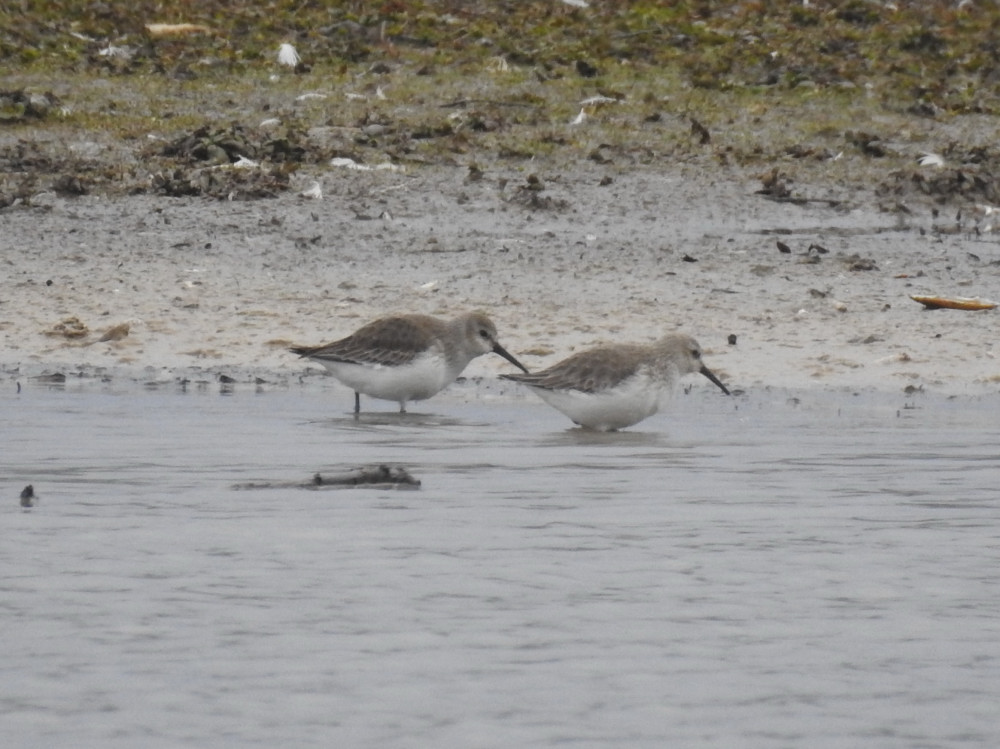
A single Dunlin was still about on March 7th but then moved on. My first Chiffchaff of the year was heard, though not singing, late on March 11th whilst I was going through the gull roost. Surprisingly, not a single Chiffchaff was seen over the Winter period, which is very unusual for this site, so this bird was a migrant from somewhere. By the 13th, there were three and numbers continued to build, as you would expect, so that by the 26th, I heard seven singing males around the lake.
On March 12th my first Redshank of the year arrived, a fairly typical first date, but as always nowadays, it only stayed the day and had gone by the following morning. A Dunlin also flew in that morning.
Despite doing several roosts in the peak period for Med Gull passage, my next Med Gull was actually seen in the early afternoon of March 13th. It was a lovely full summer adult, always a delight to see.
The morning of March 17th saw the return of freezing temperatures and snow flurries. I had dropped my son off at sports club and decided to spend an hour at the lake to see whether there had been any cold weather movement of waders, as we had seen during the previous cold snap. Viewing was not pleasant, as I had a biting easterly blowing straight into my face, but I wrapped up with multiple layers, hat, gloves and scarf and it was at least bearable for a short period. I found my first Little Ringed Plover of the year, huddled up and still on the east side of the spit, facing the easterly and probably wondering why it had bothered to fly all this way! About ten minutes later, a casual glance skywards and I was watching three birds flying more or less overhead and due south. Through bins I could see that they were three Sandwich Terns, unbelievable! I'm not surprised that they were flying south, probably hoping for some nicer weather. I have seen an early Sandwich Tern here before, a few years ago, on March 15th - that bird unusually stayed for two days. These three were silent as they flew and I am thankful that I looked upwards when I did or they could easily have flown over unnoticed.
On March 19th, I found a 1st winter Yellow-legged Gull early on, resting on the spit. We don't get too many of these at this time of year, so nice to see. There were also increases in the numbers of other species, which may well have been a result of the returning cold weather: 32 Snipe were feeding out in the open on the spit; my largest flock of Fieldfare of the Winter feeding in the northern fields, 140 birds and unusually, two Meadow Pipits feeding on the spit - they are usually in the northern fields or flying over.
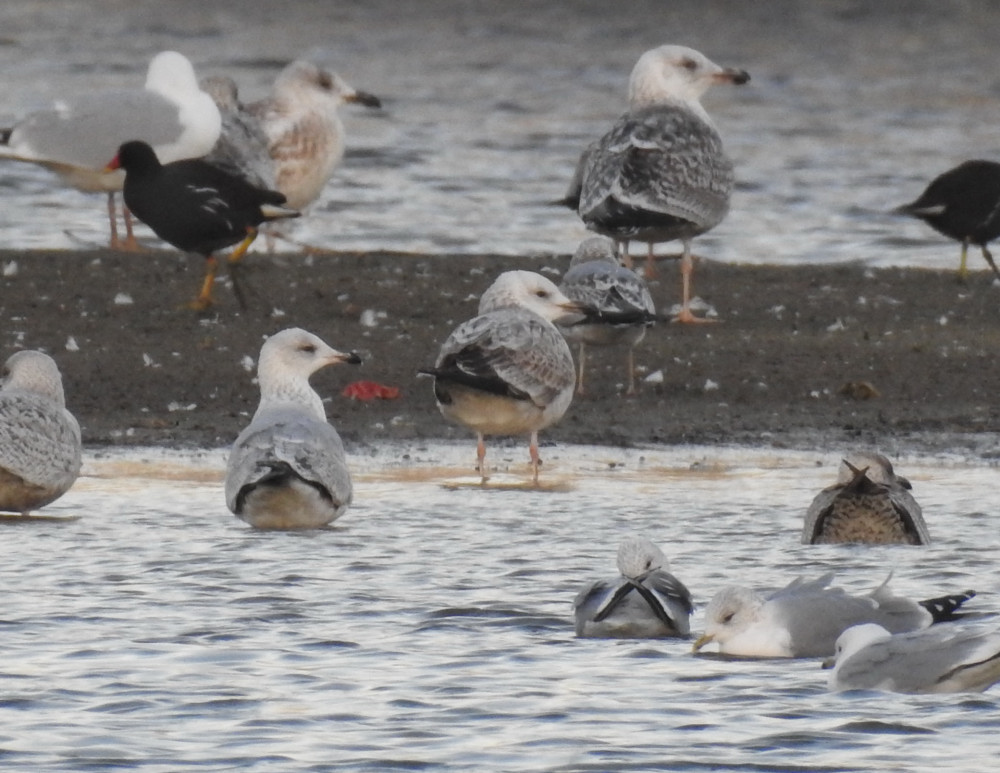
On March 20th, I had a brief slot where I could watch the gull roost for the last twenty minutes or so of light. I decided to give it a go, as Dave C had seen an adult Med Gull during the afternoon - I was glad I did! Arriving at 6:15pm, I quickly found a lovely 1st winter Caspian Gull (my attempted record shots didn't really show it clearly) and then picked out a/the adult summer Med Gull roosting head in back on the near spit, though just as I did, this portion of the roost took to the air and mainly reassembled further back - they do this all too frequently at times and it can be a bit frustrating if you have picked something out. By 6:30pm, I decided that the light had dropped too much and was packing my scope up to leave when, looking towards the south west corner, I saw a large white bird flying and banking around. I thought it was probably a Mute Swan, but when looking through bins, it was a clearly a large egret. I knew this was a Great White Egret and so quickly made my way to the viewpoint. I could see the bird through the bare branches of the trees standing on the far side of the nearest island, but it may have seen me and almost took flight. I watched it fly towards the main island, where luckily, it landed on the dead tree branches on the south side. I attempted to take a record photo as it flew, but my usual camera settings were not working in the failing light. When it landed, I switched to an auto setting and managed to take a recognisable image - this was at 6:35pm. Whilst sending out news, I took my eye off it and it disappeared, so I don't know whether it moved to the thicker trees on the island to roost or took off to another site. Either way, it wasn't seen again. This is still a rare bird here, though I have now seen three of the four I think have been recorded here. The last two have been very brief visitors.
On March 21st, I paid a late visit to my Barn Owl site, which has failed to deliver so far this year. Unfortunately, it failed again! I did, however, get a bonus Woodcock that flew over low very late. I was really pleased with this, as I don't think there have been any near the lake this year, so thought this was one I wasn't going to see this year.
My next visit was early on March 25th. There had been a big overland movement of Common Scoter overnight and many had been found on local waters across the midlands. This site is not known for Common Scoter and unfortunately it did not share in the influx. Best I could manage was a summer plumaged Little Grebe on the south side (not that regular here) and the Cetti's Warbler, now in song, on the north side. As I was making my way round the lake, I met Ben H who told me he'd just had a pair of Goldeneye swimming out of the south-east corner. Now this would be good, a surprisingly scarce species here and one that I failed to see in 2017. We made our way through the trees to the lakeside and sure enough just to the south of the main island was a splendid pair of Goldeneye. As I was pointing them out to Ben, they suddenly took flight and I watched them fly away west and over the trees. I thought that would be the last that I saw of them, but on the 27th, whilst I was standing on the east side of the lake, a series of loud bangs went off as the bird scarer fired from across the river. Shortly later, small flocks of Tufted Ducks started to fly in that had presumably been on Randall's lake (they often seem to prefer this lake) and then the pair of Goldeneye. So on the 25th, they had presumably just relocated to Randall's.
March 26th was fairly uneventful, though there were three Little Ringed Plovers on the spit and the Little Grebe was still present. Seven Chiffchaff were singing around the lake and my first Blackcap in song was also present on the east side.
March 27th saw my first arrival of Sand Martins for the year. A single bird over mid morning was followed by a lingering flock of 20 birds feeding on a large emergence of midges in the south east corner and then another single over later on. The morning of the 28th saw 11 more birds, with nine and two through. It's great to see these birds back on patch, just hope the weather begins to improve for them as well.
Little Marlow GP is my local birding patch in South Bucks. This is a record of the birds seen during my regular visits. It includes record photos of many of my sightings, but I am not a photographer, so do not expect good quality images! Follow me on twitter: @Adamdbassett
Wednesday, 28 March 2018
Wednesday, 7 March 2018
The 'Beast from the East' delivers
The day after my last post, Feb 27th, I tried to get some better photos of the Hawfinches in the churchyard/Manor House gardens. I did slightly better than my first attempt, but they were never easy and remained fairly elusive and usually hidden away or behind branches and foliage. It was also difficult to be sure how many birds were there, as they never seemed to be on view at the same time. I certainly saw four at one time, but felt that there were probably more than that. The highest single count to date has been nine birds, seen by Jim R on the 2nd and in fact I don't think any have been seen since, so it will be interesting to see if they have moved on or are just being their normal elusive selves.
On the 2nd, Jim R made a visit in similarly horrible conditions and discovered a godwit, which he identified as a Bar-tailed, though it seemed to depart shortly after being found. There were also now two Dunlin.
Simon R was down early on the 3rd. The previous couple of days' snow was thawing quickly and temperatures had positively rocketed to high single figures! He found a godwit again and assumed that it must be the previous day's bird. By the time Graham S had joined him, despite being distant, they were sure it was Bar-tailed. Mike M was present also and found a cracking male Goosander out on the east side of the lake. I arrived around 10:30, quickly saw the Goosander and then made my way to the south bank to look for the Barwit, which was right at then base of the east side of the spit. As I reached Simon and Graham, they told me that the godwit had just walked into some adjacent vegetation and was out of view. I have no idea what this bird was doing, but an hour and a half later, when I had to leave, the bird had still not reappeared. This was gutting, as Barwit is a rare patch bird - I have only had two previous records, both in 2011 when there was a large overland passage of this species. Typically, later in the afternoon the Barwit reappeared on the spit. I had to wait until 5pm to make a return visit and finally saw it reasonably close on the west side of the spit, but roosting. Still, a great birds to see and all thanks to the weather. There were also now three Dunlin present. Not too far away at Dorney Lake, Dave C had found 16 Dunlin, Sanderling, Ruff and Redshank, so more displaced waders.
I decided to make an earlier start on the 4th and was walking towards the lake at 7:45am. As I did so, I heard an unfamiliar call overhead. Looking up, I saw a gull fairly high up and flying east. A quick look through bins revealed an adult Little Gull, superb! It looked to still be I winter plumage and continued flying eastwards over the main island and then veered north eastwards, but kept on going. A great start to the morning. Somewhat surprisingly, the Barwit was still present and there were now four Dunlin. I decided to watch from the viewpoint and managed to get some better shots of the Barwit. An Oystercatcher flew in and the Barwit seemed very happy to join up with it and they spent some time feeding together.
Just before 9am, I noticed an adult winter Little Gull descend to the near spit and land on the water just behind it. Could this be the same bird that I had seen over an hour ago, or was I looking at a second? I'll probably never know, as both were non-breeding adults, but whether one or two birds I didn't care as I could now spend time watching this little beauty at close range. It decided to come out of the water and spent a few minutes standing on the spit with the Black-headed Gulls before taking flight, making the same call I had heard earlier and then flew off west over the STW.
I made my usual circuit on the morning of the 6th, the Barwit had gone, being last seen on the 5th, a stay of four days and the previous day's four Dunlin had dropped to two. I counted the Shoveler and reached 68 birds, a reasonable total. They always seem to build in number as Spring approaches before departing en masse. Strangely, all the Wigeon left the site a couple of weeks ago - really odd and I'm not really sure why, but there were four Shelduck.
As I approached the northern fields, I noticed some Meadow Pipits on the wires. They soon took flight and I counted 13 birds as they flew over the middle hedge to the field the other side. This area often produces flocks of Mipits in the Spring as they migrate through and I have seen up to 80 birds together in the past. I passed the hedge and began to watch the Mipits feeding in the field. A few took flight to the top of the adjacent hedge and as I followed them, I suddenly noticed a Stonechat perched up a little bit farther up the hedge. I am pretty sure that I would have missed this if not for the Mipits, so was well pleased. I have only ever seen one previous Stonechat here in Spring, with most of my records being Autumn migrants.
With the onset of Spring upon us, I cant wait to see the returning summer birds in a few weeks, when patch birding should really take off.
The long forecast cold easterly air, straight from Siberia, as ever nicknamed 'the beast from the east', began to take hold last week. By mid week, there were signs of cold weather movements of birds, mainly Lapwings and Fieldfares from my own observations. Small flocks could be seen moving west and south west ahead of the ever decreasing air temperatures. By the 28th, probably the coldest day of the week with temperatures here peaking at -3 degrees, there had been a small displacement of waders locally within the county. There were reports of Dunlin, Ruff and even Knot from various sites. On the 1st, I decided to take a quick look at the lake to see whether there had been any new arrivals. I didn't stay too long because temperatures were below freezing and there was an uncomfortably strong easterly blowing, part of storm Emma. In fact, the lake was about as empty of birds as I had ever seen it. Only a small part of the north western arm was frozen, as the strong winds seemed to be keeping ice at bay on the main lake, but almost all of the ducks seemed to have departed and the spit looked devoid of birds. I eventually found a lone Dunlin making its way around the spit edge near the main island, but left shortly after.On the 2nd, Jim R made a visit in similarly horrible conditions and discovered a godwit, which he identified as a Bar-tailed, though it seemed to depart shortly after being found. There were also now two Dunlin.
Simon R was down early on the 3rd. The previous couple of days' snow was thawing quickly and temperatures had positively rocketed to high single figures! He found a godwit again and assumed that it must be the previous day's bird. By the time Graham S had joined him, despite being distant, they were sure it was Bar-tailed. Mike M was present also and found a cracking male Goosander out on the east side of the lake. I arrived around 10:30, quickly saw the Goosander and then made my way to the south bank to look for the Barwit, which was right at then base of the east side of the spit. As I reached Simon and Graham, they told me that the godwit had just walked into some adjacent vegetation and was out of view. I have no idea what this bird was doing, but an hour and a half later, when I had to leave, the bird had still not reappeared. This was gutting, as Barwit is a rare patch bird - I have only had two previous records, both in 2011 when there was a large overland passage of this species. Typically, later in the afternoon the Barwit reappeared on the spit. I had to wait until 5pm to make a return visit and finally saw it reasonably close on the west side of the spit, but roosting. Still, a great birds to see and all thanks to the weather. There were also now three Dunlin present. Not too far away at Dorney Lake, Dave C had found 16 Dunlin, Sanderling, Ruff and Redshank, so more displaced waders.
| A good record, scarce and usually short stayers |
Just before 9am, I noticed an adult winter Little Gull descend to the near spit and land on the water just behind it. Could this be the same bird that I had seen over an hour ago, or was I looking at a second? I'll probably never know, as both were non-breeding adults, but whether one or two birds I didn't care as I could now spend time watching this little beauty at close range. It decided to come out of the water and spent a few minutes standing on the spit with the Black-headed Gulls before taking flight, making the same call I had heard earlier and then flew off west over the STW.
I made my usual circuit on the morning of the 6th, the Barwit had gone, being last seen on the 5th, a stay of four days and the previous day's four Dunlin had dropped to two. I counted the Shoveler and reached 68 birds, a reasonable total. They always seem to build in number as Spring approaches before departing en masse. Strangely, all the Wigeon left the site a couple of weeks ago - really odd and I'm not really sure why, but there were four Shelduck.
As I approached the northern fields, I noticed some Meadow Pipits on the wires. They soon took flight and I counted 13 birds as they flew over the middle hedge to the field the other side. This area often produces flocks of Mipits in the Spring as they migrate through and I have seen up to 80 birds together in the past. I passed the hedge and began to watch the Mipits feeding in the field. A few took flight to the top of the adjacent hedge and as I followed them, I suddenly noticed a Stonechat perched up a little bit farther up the hedge. I am pretty sure that I would have missed this if not for the Mipits, so was well pleased. I have only ever seen one previous Stonechat here in Spring, with most of my records being Autumn migrants.
| Distant crops - bird was 80-100 yards away |
With the onset of Spring upon us, I cant wait to see the returning summer birds in a few weeks, when patch birding should really take off.
Monday, 26 February 2018
Hawfinch makes a 2018 appearance
Since my last post, as with many other local inland water bodies, Oystercatchers have returned. The first bird was seen during half term week, when I was away. I caught up with my first bird last week on the 21st and by the weekend, there were two. They have never bred here, though last year there were signs that they might, but there are usually 2-4 birds around until the summer. Last year a pair appeared in mid summer with a well grown youngster and stayed a while. They may well have been signs of local breeding success.
Prior to last Autumn, the only patch Hawfinch I had seen and I think was also a patch first, but I'm not sure on that, was a female that spent some time around the churchyard during the first winter of 2006. This is not an area that I actually stop to look around very often, though I had been doing very slow drive bys as I passed in the hope of seeing a Hawfinch sitting up in the trees. Last Friday, the 23rd, Tom C actually stopped to look properly and came across at least three Hawfinches in trees around the churchyard and also in the adjacent manor house. Further sightings that day revealed at least five birds.
Saturday morning found me actually in the churchyard for once and it was not long before I could hear the distinctive call of Hawfinch. Three birds eventually appeared, either feeding in yews or atop tall trees calling. It was difficult to tell exactly how many were there, but I think at least five and possibly more. They weren't together in one flock at any time and the most I saw at one time was three as they flew over. That morning, I met David B, a birder I don't know, who said that he thought he'd had a Hawfinch here on January 26th, so these birds could have been here for some time undetected. It is fantastic to get the chance to see these birds again on patch and also to actually see them on the deck as opposed to last year's migrating birds, lovely though those were. I only managed one reasonable record shot of a male, but hope to be able to get better views if they stick.
Also present that morning was a male Blackcap feeding on Mistletoe. This was my first of the year anywhere, so nice to get it on patch. There was also singing Nuthatch and a pair of prospecting Ring-necked Parakeets. A reminder that you should always check all corners of your patch rather than just concentrate on the favoured areas.
I have been checking the gull roost as often as I am able, but it has been fairly unproductive in terms of the scarcer gulls to date. Yesterday, despite the freezing easterly blowing right in my face, I decided to check it again. I had been surprised at the lack of Med Gulls amongst the 5-6,000 smaller gulls, especially as mid February through March is one of the best times to pick them up on passage. I had also missed a lingering daytime bird a few weeks back. Anyway, it was with no great surprise that an adult Med Gull did arrive in the roost yesterday. The black hood was almost complete, just a few white feathers above the bill and hopefully the first of a few this season. A short while later, a nice 1st winter Caspian Gull appeared, though as with past birds this year, something disturbed the gulls and the Caspian flew off. I've had four Casps so far this year, three 1st winters and an adult and all the 1st winters look to be different birds.
I keep hoping for an Iceland/Glauc and will continue to check the roost when I can. Now off to brave the cold weather again to see what I can find.....
Prior to last Autumn, the only patch Hawfinch I had seen and I think was also a patch first, but I'm not sure on that, was a female that spent some time around the churchyard during the first winter of 2006. This is not an area that I actually stop to look around very often, though I had been doing very slow drive bys as I passed in the hope of seeing a Hawfinch sitting up in the trees. Last Friday, the 23rd, Tom C actually stopped to look properly and came across at least three Hawfinches in trees around the churchyard and also in the adjacent manor house. Further sightings that day revealed at least five birds.
Saturday morning found me actually in the churchyard for once and it was not long before I could hear the distinctive call of Hawfinch. Three birds eventually appeared, either feeding in yews or atop tall trees calling. It was difficult to tell exactly how many were there, but I think at least five and possibly more. They weren't together in one flock at any time and the most I saw at one time was three as they flew over. That morning, I met David B, a birder I don't know, who said that he thought he'd had a Hawfinch here on January 26th, so these birds could have been here for some time undetected. It is fantastic to get the chance to see these birds again on patch and also to actually see them on the deck as opposed to last year's migrating birds, lovely though those were. I only managed one reasonable record shot of a male, but hope to be able to get better views if they stick.
Also present that morning was a male Blackcap feeding on Mistletoe. This was my first of the year anywhere, so nice to get it on patch. There was also singing Nuthatch and a pair of prospecting Ring-necked Parakeets. A reminder that you should always check all corners of your patch rather than just concentrate on the favoured areas.
I have been checking the gull roost as often as I am able, but it has been fairly unproductive in terms of the scarcer gulls to date. Yesterday, despite the freezing easterly blowing right in my face, I decided to check it again. I had been surprised at the lack of Med Gulls amongst the 5-6,000 smaller gulls, especially as mid February through March is one of the best times to pick them up on passage. I had also missed a lingering daytime bird a few weeks back. Anyway, it was with no great surprise that an adult Med Gull did arrive in the roost yesterday. The black hood was almost complete, just a few white feathers above the bill and hopefully the first of a few this season. A short while later, a nice 1st winter Caspian Gull appeared, though as with past birds this year, something disturbed the gulls and the Caspian flew off. I've had four Casps so far this year, three 1st winters and an adult and all the 1st winters look to be different birds.
I keep hoping for an Iceland/Glauc and will continue to check the roost when I can. Now off to brave the cold weather again to see what I can find.....
Wednesday, 7 February 2018
The first five weeks....
Well I've made a reasonable start to 2018. January is often a quiet month on patch and can get a bit monotonous as there is generally little movement and we didn't have any good hangers on from 2017 to keep us going. Once you've checked that no new water fowl have arrived overnight, you tend to look through the same birds that you've seen the day or week before - the gull roost is the exception to this and can provide interest as the scarcer gulls move about - one night there might be a Med Gull, another night a Caspian and I keep checking for the scarcer white-wingers.
Having said this, I've actually had my second best January ever, reaching 79 species by the month-end, only surpassed in 2016 when I had 82. I'm three ahead of last year at this stage, though it's a bit of swings and roundabouts until Spring passage kicks in.
Best bird by a country mile has been a Whooper Swan. This adult bird arrived during the afternoon of the 30th. It had not been seen during my morning round or Alan S's early afternoon round, but was found by Mike M at about 1:30pm. I couldn't get back to site until 3pm, but found the bird on the far east side of the spit swimming up towards the works bay. This is about as far away from any lake edge that you can get and coincidentally is exactly the area chosen by a family party of Bewick's Swans back in December 2010. There were obvious assumptions being made that this was the same adult bird of unknown origin that had graced the patch almost daily from late June last year until early/mid October when it disappeared. However, even though I could only get distant record shots, the appearance of both birds seems different, most notably the pattern of yellow on the bill and the shape of the bill. Whilst watching the swan, it was also interesting to note how alert, yet tired, it seemed: alert in that it was constantly swimming with upright neck, but also kept closing its eyes as if trying to rest. Coupled with the fact that it remained to at least 3:45pm but was not seen the next day or again, here or locally, led me to give this bird the benefit of the doubt. So a great way to round off January with an ultra rare patch bird (I'm not even sure that it was on the site list!) and a patch tick.
The gull roosts that I have done have only been rewarded with scarcer gulls on two occasions and that is despite there being upwards of 6,000 gulls to look through. Most of these are generally split between Black-headed and Common Gulls, but there are also around 1,000 large gulls to sift through and in excess of 100 Great Black-backed Gulls, which are still coming in in good numbers at the moment. An adult Yellow-legged Gull came in late on Jan 6th (we generally do much better for these in June/July) and two Caspian Gulls were seen on Jan 13th, a striking brute of a 1st winter, undoubtedly male and a more petite adult, which may well have been the bird I saw back in December. I didn't manage photos of any of these as the light and distance were against me!
Other good January birds were a Dunlin on the 9th. I watched this bird fly in to the spit mid morning, though there were apparently three birds by mid afternoon, so obviously a few flying around that day; a fly through Peregrine on the 22nd and a Cetti's Warbler on the 30th. I was particularly pleased to see the Cetti's, as there had been one (and two for a while) around since last summer, but I hadn't seen or heard one since mid December. I am hoping that with the increased sightings over the past couple of years that they are on the verge of colonising.
Other than that, as I noted at the start, it has been usual January fare. No unusual ducks yet, though I managed to miss two separate records of Pintail, a four and a two on two dates. Shelduck probably the best and being seen on most visits, with up to three birds, a pair and a separate male.
I had a nice visit to the farmland part of my patch on 5th Feb and added a further three species for the year. The game cover has been cut down recently and attracted a large flock of finches. I watched them flying between the hedgerow and the stubble to feed on fallen seeds. There were in excess of 150 Chaffinches and amongst them, 2-3 Brambling, about 10 Yellowhammers and a few Reed Buntings. The usual Winter flock of Linnets was also present and numbered around 90 birds. It was also nice to see two Grey Partridge following the birds I saw last year. I think I was a bit harsh on those in not counting them on my list, as even if they have been released, which is not definite, they are at least as worthy as all the Red-legged Partridges and Pheasants that I merrily count each year, so I have upgraded them this year and ought to do a retrospective 'add 1' to last year's total.
I also saw a nice 1st winter Yellow-legged Gull loafing with a group of Herring Gulls on the 5th. It was rather a smart looking bird, a shame that my record photo is a bit over exposed in the bright sunlight to do it proper justice.
So that's about it so far in 2018. I'm on 83 for the year, which is my quickest to this total since I started keeping accurate year lists in 2014 (the start of patchwork challenge). There is still time to get some the scarcer Winter birds before Spring kicks in, but there a few gaps this year - Woodcock is looking doubtful as the regular roosting birds we used to get seem to have deserted since the mass felling of trees on the north side; I haven't come across any wintering Chiffchaffs this year (unusual), which doesn't bode well for picking up Siberian Chiffchaff, which has shown up in three of the last four years; I haven't seen or heard any owls yet, though hopefully at least two species will show up sooner or later - I think Little Owl is no more, unfortunately, my last record on patch was from 2014.
Having said this, I've actually had my second best January ever, reaching 79 species by the month-end, only surpassed in 2016 when I had 82. I'm three ahead of last year at this stage, though it's a bit of swings and roundabouts until Spring passage kicks in.
Best bird by a country mile has been a Whooper Swan. This adult bird arrived during the afternoon of the 30th. It had not been seen during my morning round or Alan S's early afternoon round, but was found by Mike M at about 1:30pm. I couldn't get back to site until 3pm, but found the bird on the far east side of the spit swimming up towards the works bay. This is about as far away from any lake edge that you can get and coincidentally is exactly the area chosen by a family party of Bewick's Swans back in December 2010. There were obvious assumptions being made that this was the same adult bird of unknown origin that had graced the patch almost daily from late June last year until early/mid October when it disappeared. However, even though I could only get distant record shots, the appearance of both birds seems different, most notably the pattern of yellow on the bill and the shape of the bill. Whilst watching the swan, it was also interesting to note how alert, yet tired, it seemed: alert in that it was constantly swimming with upright neck, but also kept closing its eyes as if trying to rest. Coupled with the fact that it remained to at least 3:45pm but was not seen the next day or again, here or locally, led me to give this bird the benefit of the doubt. So a great way to round off January with an ultra rare patch bird (I'm not even sure that it was on the site list!) and a patch tick.
| Heavy crop, as distant |
| Even heavier crop to show detail of bill |
| Last year's bird for comparison. Note the apparent differences in bill pattern and structure |
Other good January birds were a Dunlin on the 9th. I watched this bird fly in to the spit mid morning, though there were apparently three birds by mid afternoon, so obviously a few flying around that day; a fly through Peregrine on the 22nd and a Cetti's Warbler on the 30th. I was particularly pleased to see the Cetti's, as there had been one (and two for a while) around since last summer, but I hadn't seen or heard one since mid December. I am hoping that with the increased sightings over the past couple of years that they are on the verge of colonising.
Other than that, as I noted at the start, it has been usual January fare. No unusual ducks yet, though I managed to miss two separate records of Pintail, a four and a two on two dates. Shelduck probably the best and being seen on most visits, with up to three birds, a pair and a separate male.
I had a nice visit to the farmland part of my patch on 5th Feb and added a further three species for the year. The game cover has been cut down recently and attracted a large flock of finches. I watched them flying between the hedgerow and the stubble to feed on fallen seeds. There were in excess of 150 Chaffinches and amongst them, 2-3 Brambling, about 10 Yellowhammers and a few Reed Buntings. The usual Winter flock of Linnets was also present and numbered around 90 birds. It was also nice to see two Grey Partridge following the birds I saw last year. I think I was a bit harsh on those in not counting them on my list, as even if they have been released, which is not definite, they are at least as worthy as all the Red-legged Partridges and Pheasants that I merrily count each year, so I have upgraded them this year and ought to do a retrospective 'add 1' to last year's total.
I also saw a nice 1st winter Yellow-legged Gull loafing with a group of Herring Gulls on the 5th. It was rather a smart looking bird, a shame that my record photo is a bit over exposed in the bright sunlight to do it proper justice.
So that's about it so far in 2018. I'm on 83 for the year, which is my quickest to this total since I started keeping accurate year lists in 2014 (the start of patchwork challenge). There is still time to get some the scarcer Winter birds before Spring kicks in, but there a few gaps this year - Woodcock is looking doubtful as the regular roosting birds we used to get seem to have deserted since the mass felling of trees on the north side; I haven't come across any wintering Chiffchaffs this year (unusual), which doesn't bode well for picking up Siberian Chiffchaff, which has shown up in three of the last four years; I haven't seen or heard any owls yet, though hopefully at least two species will show up sooner or later - I think Little Owl is no more, unfortunately, my last record on patch was from 2014.
Tuesday, 2 January 2018
A review of 2017
2017 has been a great year on patch with 149 species seen in total of which I managed 146. This is a whole 10 species higher than my previous best of 136 in 2014 and included five patch ticks!
I've tried to capture the best birds below:
| 21 Barnacle Geese assumed to be part of a cat C population moving around in the cold weather in late January |
| Only two Red-crested Pochard records this year - this one in February |
| A 2w Med Gull in February - fewer records than normal this year |
| This 1w female Ferruginous Duck appeared on 27th Feb - a self found patch tick for me, but still with BBRC |
| A scarce Brambling in March, only my 2nd on patch |
| The first of two drake Garganey arrived in March |
| Arrived during rain on the same day as the 1st Garganey in March and stayed for only 5 minutes. Third record in 2 years, but still rare here |
| These two Little Gulls came through in late March |
| Surprisingly, my only Arctic Tern record of the year - in mid April |
| April 20th and this fantastic pair of Black-winged Stilts remained all day for me to see them after work - not surprisingly a patch first |
| Conditions were right on April 30th for this Black Tern to pass through. Two Little Terns and a Temminck's Stint also appeared that day, all seen but not photographed. |
| More Black Terns passed through early on May 1st |
| My only Redstart was a late female in mid May |
| A summer plumaged Little Stint in mid May was just my second on patch - rare! |
| This pair of beauties in early June were just my second on patch |
| Mandarins are never easy here, but this female stayed a month during its moult |
| Yellow-legged Gulls started to appear in small numbers post breeding in June, but numbers were down this year. |
| An unringed adult Whooper Swan arrived in late June and remained until early October. Its origin is unknown, but I did not count it as suspected a feral bird. |
| An unexpected visitor was this drake Scaup in early July |
| By the end of July when it departed, it was looking quite tatty |
| For the second year running, Reed Warblers raised a Cuckoo. It could be found in July calling loudly for its food. |
| My only Greenshank was in early August |
| I watched three Sandwich Terns arrive on Aug 6th. Amazingly, I had another fly through four days later. |
| This juvenile Spotted Redshank was a brief visitor on Sep 1st. Another was present a week later - scarce birds here. |
| Only my second patch Marsh Tit was a surprise find in September |
| Ravens were much in evidence in September |
| Two Ruff in early September were followed by a fly through in October |
| Thought I'd missed Spotted Flycatcher this year, until this beauty turned up on Sep 19th |
| Two more moulting adult Black Terns passed through in late September |
| My find of the year was this Yellow-browed Warbler, from Sep 27th to Oct 2nd, a site first. Photo copyright Mike Wallen. |
| A site second Great White Egret was present briefly on a murky mid Oct day |
| Only one Caspian Gull in the 1st winter period, this 1w in mid Oct was my second but has been followed by about four others including an adult and 3w by year-end. |
| Usually very brief, scarce visitors, three Goosander stayed for 2 weeks from late Oct and a further single stayed until late Nov |
| Three Pintail were present for a day in late Oct and a further five for a day in late Nov |
So a great year in 2017, the pictures bringing back some fantastic memories. Hopefully 2018 will be equally as good.
Subscribe to:
Posts (Atom)