Wednesday, 10 August 2016

Mandarin

Dave C saw two Mandarin on the spit edge late afternoon on August 1st.  This is a tricky species to get on patch, though is just about annual, so I was keen to see them.  I wasn't able to get straight down, but when I did arrive, they had typically both departed.  So I was very pleased when I popped in after work on the 5th and found what was almost certainly one of the same birds back feeding on the spit.


Pied Flycatcher

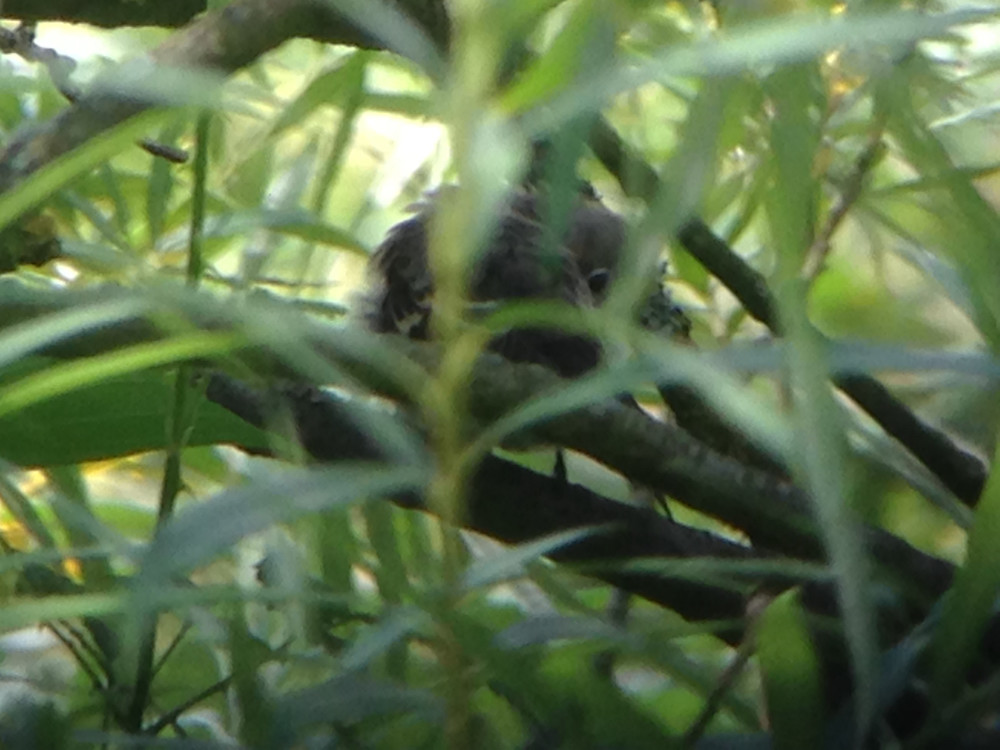
This was a great record and might well have not been picked up.  A visiting birder from Yorkshire, Graham Brown, located a female Pied Flycatcher in the SE corner of the pit, flitting around in a small stand of oaks.  Alan S sent a message at about 2pm informing the locals of the sighting, but had not had time to confirm it, though it sounded like Graham was very familiar with the species.  I eventually managed to get down at about 4pm, by which time Alan was leaving.  Graham was still present sitting on the bench, so we had a quick chat.  He had seen the bird in the early afternoon and watched it for a few minutes but it then seemed to go missing.  I made my way round to the SE corner and waited no more than a couple of minutes before the Pied Fly appeared at the top of the nearest oak.  Boom!  This is only my second record here following another female last Spring and it remains a rare bird on site.  Whilst sending out messages of its continued presence, the bird vanished.  However, it reappeared at the north end of the stand of oaks and then flew across the path into the lakeside willows.  Here it began to preen for a short while and I tried to phonescope a record shot before it was off again.  Considering it was back on and through leaves, I was surprised that anything recognisable came out at all, but you can make out the white tipped coverts and white edged tertials along with the pale eye ring.


The following day there was no news, until Dave C said that he thought he had seen the bird briefly late afternoon.  I popped in after work and made my way round to the SE corner.  I didn't see anything for a while, but then the bird reappeared within the last oak.  This seemed to be its favoured tree, but it was very difficult to keep track of and kept disappearing behind foliage.

The bird remained the next day too, so three days on site, but was not reported subsequently.  An excellent and protracted stay - thank you Graham!

Whimbrel

A quick visit after work on the 21st July was rewarded with a fleeting visit by a Whimbrel.  This bird flew in silently and luckily flew through my scope or I might have missed it.  It landed almost out of sight behind vegetation but then proceeded to feed along the edge of the spit.  About five minutes later, for no apparent reason, it too off calling as it went and departed to the north.  This is only my second Whimbrel this year, following an equally brief bird in the Spring.


Black-tailed Godwits

The pit experienced a good passage of some lovely breeding plumaged adult islandica Black-tailed Godwits.  Between June 29th and July 4th, ten birds passed through.  The first record was a flock of seven birds that came in after rain on June 29th.  I went down to see them an hour and a half after they arrived to find that they had gone!  Fortunately, the following day, a further two birds appeared and these had the decency to remain until after work so that I could add my first year tick in about 6 weeks.


There is a short video of them here

These birds stayed until July 1st.  Another bird arrived on July 3rd and stayed until the 4th.

It's been a while......

10th August - I haven't been updating my blog recently for a couple of reasons: not much was happening in the quiet month of June; I have been using twitter to post quick messages and photos of any interest.  I would encourage anyone to follow my twitter feed to see quicker updates than appear on here:

https://twitter.com/Adamdbassett

However, there have been some notable birds from the end of June and July, so at the risk of repeating myself, as much if not all of the following is on twitter, I will try and provide an update, mainly in pictures, in the next few blog posts.

Friday, 27 May 2016

Spring fizzles out

It's been a while since my last post.  I've started posting quick news and updates on twitter, as it's a bit easier and quicker to get news out:

https://twitter.com/Adamdbassett

Anyway, as Spring seems to have fizzled out on patch, here are the highlights of the previous fortnight:

May 12th: Black and Arctic Terns continued to pass through in small numbers.  I was at work, but visited in the morning, when there none of either species.  They arrived during the morning, but only the 2 Black Terns and a single Arctic (3 reported earlier) were present in the evening when I popped in after work.  As I watched with Alan S, Greenshank called and two birds flew over and landed on the spit, joining the single bird already  present. A single Ringed Plover was also still present.

May 13th: Once again, a pre work visit found no terns other than Common, though the Greenshank and Ringed Plover remained.  Alan S arriving later in the day had another summer plumaged Little Gull arrive and up to 9 Arctic Terns.  Best of all though was a singing Cetti's Warbler on the south bank - a rare bird here.  I arrived in the evening after work and had lovely views of the Little Gull, though there were no Arctics left by this stage.  The Cettis was still singing on and off though, only my second here following a bird that was around for about 3 weeks last August/September.  I have a feeling that once this site is found by Cetti's, it will become more regular.

A nice flight shot of the Little Gull here:

Picture 1

May 14th: Surprisingly, the Little Gull remained for a second day, though I was unable to go and see it again. This was the final day of the Greenshank's visit.

This was the end of the period of easterlies and migration pretty much dried up after this.  Other highlights since then have been an unseasonal male Wigeon on the 19th and 20th.  The 21st was a bit damp and an early Ringed Plover found by Jackie N was joined by two more as I watched in the early evening.  There were also large numbers of Swifts zooming about in a transient flock - I estimated at least 400 birds, which brought with them a passing Hobby.  A 2cy Great Black-backed Gull was also a late bird and probably a lingering individual seen earlier in the month. Phone-scoped record shots below:


The Cetti's Warbler has remained throughout, often very vocal and audible from some distance away.  I captured a short video of it singing from an unseen perch here:

https://youtu.be/x2m9d2KB984

Up to two pairs of Shelduck are still frequent visitors, though more often than not just a single pair.  I think any breeding attempt would probably be doomed to predation on this site.

Some of our commoner breeding warblers are now in in good numbers, a walk around the site on the 23rd and 24th found 6 Garden Warblers (5 singing males) and 8 Reed Warblers, all singing males, plus two male Whitethroats, which are a scarcer bird on patch.  There are also plenty of babies appearing.  All the geese have reared some young: Egyptian, Canada, Greylag and feral; Grey Herons and Cormorants all have young; the first Mallard ducklings are about along with Moorhen and Coot and the tern rafts look to be holding well into double figures of Common Terns.

There were 9 baby Coots here, but reduced to just 3 a few days later.
Finally, I captured one of the reasons why we see Oystercatchers so frequently here, not for breeding, but to feed on the plentiful supply of fresh water mussels.


Wednesday, 11 May 2016

Damp south easterlies end a quiet spell

The patch has been going through a quiet spell, so I haven't really felt like blogging too much.  Since my last post, the best birds seen have been:

April 29th: a summer plumaged Dunlin arrived and began a five day visit.


The same day I had my first Hobby of the year, in fact two birds flew over together in the evening.

April 30th: the two female Wheatears first seen on the 27th were still in the horse paddocks at Pump Lane, with one bird remaining to the 1st May.

May 1st: having not seen a Cuckoo on patch last year, it was gratifying to hear a male bird fly past me and into the trees at the base of the spit.  Alan S texted me at the same time to say he had heard a Cuckoo calling near the STW, which had flown to the same trees on the spit.  This seemed a bit odd.  However, I made my way to where he was sitting and immediately saw a Cuckoo fly from the west bank to the spit.  I saw where it landed and scoped it intending to take a record shot, but it flew.  Whilst I was watching it, I could hear a Cuckoo calling, but it was not this bird, as its beak was not opening.  There must be two birds.  Sure enough, a Cuckoo soon flew out of the trees, followed shortly later by a second bird.  Two male Cuckoos - a welcome return.

A 2cy Great Black-backed Gull on the spit was a late date for this species.

May 3rd: my first large flock of Swifts for the year, with about 100 birds wheeling about.  Reasonable numbers of warblers moving through as well for this site, with 4 Garden Warblers, 3 Sedge Warblers, 3 Whitethroats, 2 Lesser Whitethroats and 3 Reed Warblers seen along with plentiful Blackcaps and a few Chiffchaff.  All the Willow Warblers seem to have moved through now until the Autumn.

May 4th: (Star Wars Day!) 6 Garden Warblers seen today, but the best bird was a 2cy Yellow-legged Gull.  Around 140 LWHG were loafing on the spit, predominantly immature Herring Gulls, but this YLG was standing apart from this flock.  I took some record shots and a short piece of video, but into the sun, the plumage detail is a bit lacking.


The video is here . You need to watch it in 720HD to give a clearer image of the plumage.

A male Pochard was an interesting late migrant and this was the final day the lone female Wheatear was seen in the Pump Lane paddocks - an eight day sojourn.

May 5th: a new male Wheatear was seen in the Pump Lane paddocks.

May 8th: a Yellow Wagtail flew over the lake calling, but otherwise migration was very slow.  A few Common Sands, up to 5 LRP and a pair of Oystercatchers have been the mainstay of waders on patch for some time now.

May 9th: A period of warm settled weather was about to finish.  As I was driving home from work, I could see that rain clouds were gathering and sure enough, rain fell quite heavily for a while.  I decided to drop into the patch after work and see if the rain had brought anything down.  It had, I saw my first Ringed Plovers of the year.  We don't often get the early birds through this site, but do usually get the later migrating tundra birds.  The Ringed Plover were often out of view over the ridge of the spit, so I repositioned myself and soon counted seven birds present.  As I was texting out news, I saw a flock of eight Ringed Plovers flying off east and assumed that it was these birds, however, a quick look back at the spit confirmed that the original seven were still there, so fifteen birds! The seven flew off north shortly later, but as I scanned the spit, a single was still there, so my final tally was sixteen Ringed Plover.  A Greenshank was also new in, but distant on the back of the spit.


May 10th: this day was forecast to be showery/rainy but with easterly/south easterly winds - a great combination for migrant birds on patch.  I wasn't able to get down until 9am, but on arrival I could see plenty of terns flying over the east side of the lake, the preferred location.  Amongst these were four Black Terns and an Arctic Tern.  I went to the eastern side to get closer views and confirm numbers and then went back to the western side.  On my return, Alan S had arrived.  He had seen two Arctic Terns, I looked back and sure enough, two birds were now there, often close together.  A while later, while scanning the Black Terns, it looked as though there were now five birds and this was confirmed later in the morning.  At about 11:20am another scan of the tern flock and I was watching an adult summer Little Gull - another new arrival.  This species has become quite scarce on patch, last year's bird being my first since 2006, so another one this year was very welcome.  I should say that the weather was basically wet throughout this period, so we were birding under umbrellas, never particularly pleasant.

The previous day's Ringed Plover was still present at 9am, but I watched a further two birds arrive mid morning to make three.  There were also three Common Sands, which became four later on.  A Greenshank, possibly the previous day's bird, arrived calling late morning and soon departed to the eastern side of the spit.

A great morning's birding, though conditions were too bad for me to attempt any record shots.  Jim R managed some great flight shots of the Little Gull considering the rain and bad light, linked below:

Picture 1
Picture 2

May 11th: heavy rain overnight and similar conditions to the previous day, though less rain. I was able to get out briefly after school drop off.  On arrival at the lake, it looked very quiet, with no obvious waders or many terns.  I made my way to the viewpoint.  Almost immediately I picked up a line of Black Terns flying low over the water, having obviously just arrived.  I counted 10 birds.  Whilst watching these start to hawk over the eastern side, I also picked up an Arctic Tern amongst them.  I then noticed a mid sized brown bird half hidden on the back of the spit expose a white wedge up its back. I quickly got it in the scope to reveal a Whimbrel, but it then decided to take off and it flew to the east calling.  A short while later, a Greenshank walked into view on the back the spit, probably yesterday's bird again.  As it walked along, a summer plumaged Dunlin landed next to it - another new arrival.  Other waders seen were a pair of Oystercatchers, a pair of LRP and a Common Sand.

I left Alan S and Jim R to see if anything else might come through.  Edit: Alan S had a flock of eight Arctic Terns through at 11:50am, though for only 10 minutes.

I was able to get some record shots of the Black Terns today, as they kept landing on the spit and also a dead branch tat has washed up near the spit.