March 14th - I was sitting at my parents' house having taken the children over for a visit, when I got a text from Alan S saying 'Great White Egret on spit'. This was just before 3pm. This was a patch tick for everybody and possibly a patch first, although one was reported to me a couple of years back, which sounded convincing, but was never submitted or seen by anyone other the observer. This was too good to miss and luckily my parents are only about 20 minutes or so drive from the lake, so shortly later I set off. I had no bins or camera on me, but the scope was in the boot, so I duly arrived at the car park and scampered off with just a scope.
Alan S, Mick M and Jim R had been working on site this afternoon, cutting back overhanging branches for the lakeside reed beds. Apparently, Mick had seen the egret and with no optics had assumed it was a year tick Little. However, Alan used his bins and could see that it was actually a Great White. All three had just bins, though Jim also had his camera with him and was able to take some reasonable record shots.
As I was nearing the lake, Alan phoned me to say that all the gulls had gone up and so had the egret, but Mick had said it was now on the north bank, so I went straight to the viewpoint to scope the white blob on the north bank It was actually a large plastic bag! Aghh, where was the egret! Luckily it was almost immediately relocated standing towards the top of the trees on the heronry. I scoped it and had my patch tick - get in! I could see that one of its legs had two colour rings on it, orange over red just above the knee. Suddenly it took off and did a little circuit around the island, but then descended and landed on the back of the spit. From here, the views were a little distant, but reasonable. I could now see that it had colour rings on the other leg too, but these looked quite grubby and were difficult to ascertain. It was dark greenish blue over yellow - this was the right leg.
The colour rings correspond to a French ringing scheme, so I have sent the details off, but with a bit of uncertainty over the green/blue colour, I wonder what the outcome will be.
I continued to watch the egret for about half an hour, during which time about a further five people came to watch it, but then returned to my parents to collect the children. A predicted bird, which is becoming ever more frequent and now joins Cattle Egret and Spoonbill as exotics that have been in the heronry over the past 12 months - what next?
Jim's record shot is here:
http://www.goingbirding.co.uk/bucks/show_photo.asp?photo_id=4227
http://www.goingbirding.co.uk/bucks/show_photo.asp?photo_id=4226
Monday, 16 March 2015

Some waders!
March 11th - I’m sure a fair few people have now seen the pale Chiffchaff at Little
Marlow GP. This is an interesting bird and well worth taking the time for a
look before it departs. It certainly looks good plumage-wise for
Siberian/tristis, as has been discussed and documented in various places. The
bird was completely silent until last week, when it started to call quite
regularly; the call it gives is an upward inflected ‘houeet’, fairly typical to
my ears of a standard collybita/abietinus. I have not heard it make the single
flat ‘pew’ call described as the typical tristis call at all. So last
Wednesday 4th, having heard this call, I was having reservations about it being a
Siberian/tristis and thought perhaps it may be abietinus, though the plumage
looks more tristis like to me. I was then interested to see that Dave Cleal had
heard it sing last Thursday, 5th – he bravely attempted to transcribe the call as
'Chifseeowchi' – this didn’t sound like the normal ‘Chiff chaff’ of collybita or
abietinus, so I was keen to hear it myself. It has taken until today for this
to happen, but this morning it was singing on and off for some time (plus giving
its frequent ‘houeet’ call). The song is nothing like ‘chiff chaff’ and sounds
very similar to the songs on xeno-canto labelled as tristis. In fact, it sounds
very similar to a bird recorded by Ashley Fisher on the IOS in April 2013 (6th
bird down on the link below):


It is also interesting to note that with that recording, he has said that
it is uploaded as a pure tristis but with reservations, one of which is that it
was giving an upward inflected ‘weet’ call.
So, is the Little Marlow bird a Siberian/tristis? It certainly seems to be
on plumage and song, but then why the different call? It does not appear to be
uncommon for this set of circumstances to be repeated in the UK with other birds
also looking and singing like tristis, but calling ‘houeet’. One hypothesis is
that the call is learnt from the collybitas it is associating with – we know
that wintering Chiffchaffs in the Med can pick up Iberian type song on occasion,
so maybe this is what has happened. I’m not sure, but if you want to hear this
bird sing, I would go soon before it leaves.
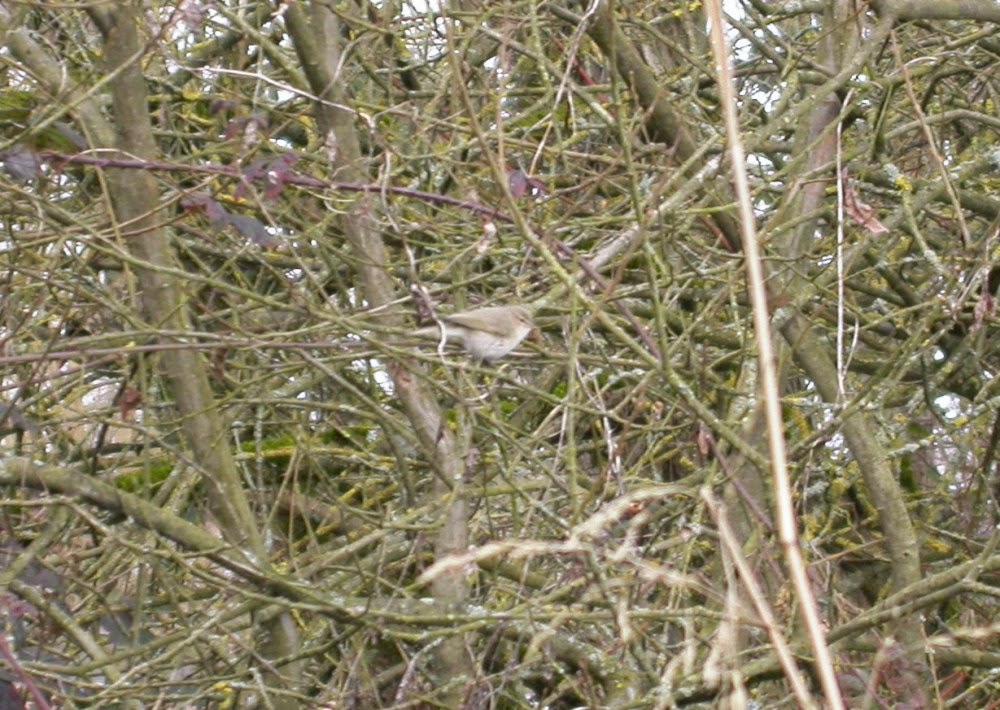
It was preening as well today, so I managed a couple more record shots using digibinning - not a method I use very often. It was in fairly strong light, so colours aren't as reflective as they might have been.
Also new in today and first for the year were a pair of Oystercatchers. They do not breed here, so are only ever migrants and are more often seen in mid summer, which I have assumed is due to failed breeders.
And finally I have had success with Woodcock, which becomes the first species on the 2015 list which I did not see in 2014. There is a regularish roost site that I check out from time to time, but with no luck for over a year (so not that regular!). However, today whilst standing in an appropriate area and seeing nothing except Pheasants, I was about to leave when my phone rang with a wrong number. Soon afterwards, a Woodcock lifted off from about 6 feet in front of me and landed in a nearby wooded area - nice!
Wednesday, 4 March 2015
Sibe Chiff record shots
2nd March - the Siberian Chiffchaff continues to show well along the western bank. I even managed a couple of record shots myself with my old point and press camera. The bird was only about 10 - 15 feet away in good flat light, but very active. These shots are still heavily cropped and so lack focus, but it gives a good overall impression on the colour. Basically a nice pale buff above, with some green showing on the remiges, though this is variable depending on the angle of the bird and can often disappear; warm buff ear coverts; white below, off-white in some areas; black legs and blackish bill, though as I mentioned before, there is some paleness in the bill. I still haven't heard it make a sound.

Wednesday, 25 February 2015
Sibe Chiff still
25th February - a quick look before school pick-up found the Siberian Chiffchaff still on show fly catching in trees around the western viewpoint. It's at times like these that I wish I had a DSLR, as it was showing nicely - a smart little bird - I'm hoping that it might start singing soon. It was the only Chiffchaff that I saw along the western bank today. A pair of Treecreepers were chasing each other noisily through the trees too, whilst on the spit an adult Yellow-legged Gull was a new addition on the gull front - poor record shot below - it was mainly head on and sitting down!

A good couple of days
24th February - I was standing on the western viewpoint this morning at just after 9am, scoping the birds on the spit, when I noticed a Chiffchaff flitting about in the over hanging willows in front of me. In the bins I could see it was a collybita. Then another one appeared, which was obviously paler. This was the pale buffy tristis type that I had seen exactly 4 weeks ago about 100 yards away in the STW complex and despite frequent searches since had not seen it again. I assume that it had wintered within the compound and for some reason the Chiffchaffs had chosen today to change their behaviour, as there were at least five and maybe more flitting and fly catching along the western bank.
The Siberian Chiffchaff showed well for about ten minutes coming within a few feet of me and I was pleased to see all the features I would expect to see on a tristis in much closer detail than my previous view in January. The mantle was a pale buff with a hint of grey. There was no obvious green feathering at all except slightly on the remiges when viewed front on - when side on, this seemed to disappear. It had an obvious creamy buff super, a dark eye stripe and darker buff ear coverts. The undersides were fairly clean and whitish, looking cleaner white on the belly and under tail coverts. The legs were black and the bill was blackish, though showed some orangey tones in good light. This last feature, I was slightly unsure about, as I was expecting a solid black bill, but I'm sure this feature shows some variability. The bird was typically silent. It flew off along the bank and I assumed that that was that, but found out during the day that it and the Chiffchaff flock would remain faithful to this hundred yard stretch of bank all day. The Siberian was often on its own not particularly associating with the collybita and also seemed to like the area around the viewpoint where it afforded good views, though slightly against the light. It was incredibly active and often difficult to keep up with through bins. LGRE turned up early afternoon and managed some decent photographs that my camera would have failed to do - they are here:
Shortly after my initial view of the Sibe, when it had flown off, I continued my scanning of the birds on the spit and picked out a winter plumaged 2nd winter Med Gull amongst c1000 BHG. It was about 200 yards away and not particularly obvious, but I grabbed some record shots:


The bird stayed about an hour before departing.
Other birds seen today included a nice Water Rail walking along the western bank, a single Shelduck and just a single Snipe.
The previous day, the 23rd, I had popped down just before midday and was pleased to see this beauty fly in at 11:40am. A lovely 1st winter Caspian Gull that arrived on its own, spent about an hour on site, mainly washing and preening before inexplicably departing on its own. I watched it fly off high to the east and maybe back towards Hedgerley landfill. It was one of only 30 LWHG on site and a little distant for photographs, but I took the following records:


Not a particularly big bird, so presumably a female. It does show some similarities to one of the birds I photographed at Hedgerley, but I'm not convinced it's the same.
On the 18th, I took a walk around Emmett's fields looking for farmland birds. The game cover has now all been cut down and I could not find the pair of Grey Partridge. I was pleased to see 4 Yellowhammers feeding amongst a small flock of 20 Chaffinches. There were 26 Stock Doves feeding on a crop field and best of all was an immature Peregrine, presumably the one seen several times over the lake (but not by me yet!). It spent several minutes circling low over the southern edge of Bloom Wood before flying off rapidly to the east.
The Siberian Chiffchaff showed well for about ten minutes coming within a few feet of me and I was pleased to see all the features I would expect to see on a tristis in much closer detail than my previous view in January. The mantle was a pale buff with a hint of grey. There was no obvious green feathering at all except slightly on the remiges when viewed front on - when side on, this seemed to disappear. It had an obvious creamy buff super, a dark eye stripe and darker buff ear coverts. The undersides were fairly clean and whitish, looking cleaner white on the belly and under tail coverts. The legs were black and the bill was blackish, though showed some orangey tones in good light. This last feature, I was slightly unsure about, as I was expecting a solid black bill, but I'm sure this feature shows some variability. The bird was typically silent. It flew off along the bank and I assumed that that was that, but found out during the day that it and the Chiffchaff flock would remain faithful to this hundred yard stretch of bank all day. The Siberian was often on its own not particularly associating with the collybita and also seemed to like the area around the viewpoint where it afforded good views, though slightly against the light. It was incredibly active and often difficult to keep up with through bins. LGRE turned up early afternoon and managed some decent photographs that my camera would have failed to do - they are here:
Shortly after my initial view of the Sibe, when it had flown off, I continued my scanning of the birds on the spit and picked out a winter plumaged 2nd winter Med Gull amongst c1000 BHG. It was about 200 yards away and not particularly obvious, but I grabbed some record shots:
 |
| You can just see the distinctive black and white primary pattern of a 2w |
Other birds seen today included a nice Water Rail walking along the western bank, a single Shelduck and just a single Snipe.
The previous day, the 23rd, I had popped down just before midday and was pleased to see this beauty fly in at 11:40am. A lovely 1st winter Caspian Gull that arrived on its own, spent about an hour on site, mainly washing and preening before inexplicably departing on its own. I watched it fly off high to the east and maybe back towards Hedgerley landfill. It was one of only 30 LWHG on site and a little distant for photographs, but I took the following records:
 |
| this gives an idea of the white underwing |
 |
| this shows the tail pattern |
On the 18th, I took a walk around Emmett's fields looking for farmland birds. The game cover has now all been cut down and I could not find the pair of Grey Partridge. I was pleased to see 4 Yellowhammers feeding amongst a small flock of 20 Chaffinches. There were 26 Stock Doves feeding on a crop field and best of all was an immature Peregrine, presumably the one seen several times over the lake (but not by me yet!). It spent several minutes circling low over the southern edge of Bloom Wood before flying off rapidly to the east.
Wednesday, 11 February 2015
Off patch gulling
With the patch being quiet, I've spent a bit of time gulling at Hedgerley landfill. This site is the one of the main sources of gulls that appear at Little Marlow, so I've been checking it for white wingers and Casps in the hope that may might appear on patch. The trouble with watching the gulls here is that the landfill owners employ a bird scarer or two, which usually involves a guy flying falcons over the site, which scatters the gulls all over the place. So you have to be lucky in terms of timing visits to coincide with lunch breaks etc to get any chance of seeing anything. That said, I went on the 9th and 10th and saw no gull scaring activity at all, so he might be off sick at the moment.
Over 4 visits on the 3rd, 7th, 9th and 10th, I've managed to see at least 4 and possibly 5 Caspian Gulls, 3-4 1st winters and an adult, but just 2 Yellow-legged Gulls, an adult and 1st winter. The usual GBBG, LBBG and the most numerous Herring Gulls and BHG with just a handful of Common Gulls. No white wingers yet though.
Unfortunately, I forgot my camera on the 7th when I saw 2 1st winter Casps, both different to the bird on the 3rd and at least one different to all these photographed. The adult above has what appears to be very yellow legs. A lot of the gulls here look like this and it is in fact the colour of the muddy sand on site. The colour of its tibia is more reflective of true leg colour.
I also saw the bird below on the 10th, which looks to me like a presumed hybrid graellsii LBBG and argenteus Herring Gull. When I first saw it, it looked like a pink legged graellsii, it certainly has the mantle shade of graellsii, though looks slightly large for that species.

I've also managed to read 22 gull colour rings. Most of these have been rung by the North Thames Gull Group at Rainham and Pitsea, but the following are quite interesting:
Herring Gull, black J5440, ringed as a pullus on 02/08/2012 in Troms, North Norway 2336km to the north.
BHG, yellow 2DST, ringed as an adult at Pitsea landfill on 08/03/2014. On the 25/03/2014 it was at Alytaus in Lithuania and now back in Bucks this winter.
Herring Gull, orange 1171, ringed as an adult at Ellington Rd Landfill, Ashington , Northumberland on 10/03/2005 and not recorded since.
Over 4 visits on the 3rd, 7th, 9th and 10th, I've managed to see at least 4 and possibly 5 Caspian Gulls, 3-4 1st winters and an adult, but just 2 Yellow-legged Gulls, an adult and 1st winter. The usual GBBG, LBBG and the most numerous Herring Gulls and BHG with just a handful of Common Gulls. No white wingers yet though.
 |
| Saw this on the 9th and 10th |
 |
| Saw this on the 3rd |
 |
| Saw this on the 9th |
 |
| Saw this on the 10th |
I also saw the bird below on the 10th, which looks to me like a presumed hybrid graellsii LBBG and argenteus Herring Gull. When I first saw it, it looked like a pink legged graellsii, it certainly has the mantle shade of graellsii, though looks slightly large for that species.
I've also managed to read 22 gull colour rings. Most of these have been rung by the North Thames Gull Group at Rainham and Pitsea, but the following are quite interesting:
Herring Gull, black J5440, ringed as a pullus on 02/08/2012 in Troms, North Norway 2336km to the north.
BHG, yellow 2DST, ringed as an adult at Pitsea landfill on 08/03/2014. On the 25/03/2014 it was at Alytaus in Lithuania and now back in Bucks this winter.
Herring Gull, orange 1171, ringed as an adult at Ellington Rd Landfill, Ashington , Northumberland on 10/03/2005 and not recorded since.
Patch doldrums
The patch seems to be going through one of its quiet spells and apart from the Siberian Chiffchaff there has been nothing of new of note on site all winter. This can be rather frustrating as you are just looking through the same old birds during each visit, however, that is the nature of patch working, but I hope that something good turns up soon, as this is set to be my slowest start to the year for a while.
Having said that, the following records are worth a mention:
A fly over Raven on the 3rd, which although annual, can be tricky to see. This bird was missing a feather or two from its inner primaries/secondaries on its right wing.
A pair of plumed Little Egrets appeared in the heronry on the 4th. I'm hoping that following last year's breeding success, they will continue to breed here. The Grey Herons and Cormorants are already busy rebuilding their nests and taking up position.
A party of 5 Bullfinches on the northern side on the 4th was also nice to get, as I had to wait until Juy to add this species last year.

Duck numbers are still holding up, but not attracting any of the more unusual species, so as yet no Goldeneye, Goosander, Pintail, Mandarin or Red-crested Pochard or anything rarer. I did count 101 Pochard and 233 Tufted Duck on the 3rd, which are reasonable counts maybe boosted by the colder weather and 1-3 Shelduck have been present throughout.
Chiffchaffs are still much in evidence, particularly in the STW, but I have failed to see the Siberian again as yet, but keep looking when I get the chance.
To the north on Emmett's fields, the game cover favoured by the pair of Grey Partridge has been cut down. On the 9th, the pair were still present but were in the crop field to the right of the main path. The newly cut game cover had attracted 12 Song Thrush (the highest number I can remember seeing together here), c30 Linnets and a similar number of Skylarks and 3 Reed Buntings, while the crops to the north held c130 Fieldfares.
Having said that, the following records are worth a mention:
A fly over Raven on the 3rd, which although annual, can be tricky to see. This bird was missing a feather or two from its inner primaries/secondaries on its right wing.
A pair of plumed Little Egrets appeared in the heronry on the 4th. I'm hoping that following last year's breeding success, they will continue to breed here. The Grey Herons and Cormorants are already busy rebuilding their nests and taking up position.
 |
| Bird 1 |
 |
| Bird 2 |
Duck numbers are still holding up, but not attracting any of the more unusual species, so as yet no Goldeneye, Goosander, Pintail, Mandarin or Red-crested Pochard or anything rarer. I did count 101 Pochard and 233 Tufted Duck on the 3rd, which are reasonable counts maybe boosted by the colder weather and 1-3 Shelduck have been present throughout.
Chiffchaffs are still much in evidence, particularly in the STW, but I have failed to see the Siberian again as yet, but keep looking when I get the chance.
To the north on Emmett's fields, the game cover favoured by the pair of Grey Partridge has been cut down. On the 9th, the pair were still present but were in the crop field to the right of the main path. The newly cut game cover had attracted 12 Song Thrush (the highest number I can remember seeing together here), c30 Linnets and a similar number of Skylarks and 3 Reed Buntings, while the crops to the north held c130 Fieldfares.
Subscribe to:
Posts (Atom)