Monday, 8 December 2014

Signs of Winter

3rd December - overnight temperatures have begun to drop, with a couple of frosts this week, which often brings about a bit of bird movement.

Today was cold, but nice and sunny and the winter ducks are beginning to look rather splendid in their full finery.  Amongst the Wigeon on the east side of the spit, a drake Pintail was newly arrived and in no hurry to move on, as it happily snoozed.  Nearby, were two females, which at the 300+ yard range I was viewing from did not stand out particularly well, as they too were tucked up and asleep.  I did see them flush off the bank once, but they soon returned to their slumber.


Shortly before seeing the Pintail, an immature Peregrine had flashed through over the spit, half-heartedly flying low through the Lapwings before continuing north.  It had also disturbed a 1st winter Med Gull from the spit that was preening amongst the BHG.  Fortunately, after flushing, it relocated to the open water, where I was able to grab a record shot:


I am assuming that this is the same bird seen back in mid November and also at the gull roost on the 30th.

A Chiffchaff was in the lakeside willows on the NE side and is one of two or three birds that are wintering around the lake, usually quite vocal. Another flock of Golden Plover, this time about 450 birds, were flying distantly over Emmett's fields to the north.  They were wheeling around for ages, but seemed unhappy to land.

Other birds of note recently were a pair of Shelduck that appeared on the 1st December and were still there the following day, another fly over flock of Golden Plover - c250 birds on the 1st and the continuing increase in the flock of Snipe on the spit - up to 13 birds on the 2nd.  Lapwing numbers are still high, with an estimated 1200 birds present on the 2nd, whilst 2-3 Water Rail are usually fairly vocal and sometimes seen on the west side of the lake.  I continue to count the wildfowl numbers on occasion, usually when they appear more obvious, and although the numbers of diving duck continue to be fairly low, the dabblers are still increasing - Wigeon are now into three figures, with 103 birds present on the 1st.

Monday, 24 November 2014

Not so Ruff!

24th November - I paid a quick pre-work visit to the patch this morning.  It was the first properly cold morning of the season, with temperatures barely above freezing.  The lake was shrouded in mist, though it was patchy and lifting, so not too much of a hardship.

I stood on the west bank and methodically scoped the birds on the spit and the lake.  A small group of seven Snipe on the left side, half hidden in vegetation, was a slight increase on recent counts.  Egyptian Geese seemed quite numerous amongst the Greylags and a quick count found 76 birds present - a reasonable total.  Otherwise, it was the usual fare - Wigeon, Teal, Shoveler and Gadwall dotted on and around the spit, a few Pochard and Tufties on the water amongst the Great Crested Grebes and large numbers of Black-headed Gulls and Lapwing.

The Lapwing would spook occasionally, as they always do and many hundreds of birds would wheel about before descending back to the spit.  Whilst they were in the air, I gave them a quick scan with bins to check for waders, as I was conscious that a Dunlin had been seen on Saturday, but I didn't notice anything through the mist.

My quick visit came to an end and I began to walk back to the car park, stopping briefly to check for a Water Rail that was 'kipping' away in the NW reed bed.  As I stood, I looked up to see a small flock of about 20 Lapwing flying past heading NW.  Amongst these was a medium sized wader.  Its size, flight action, long wings, long neck, mid sized slightly drooping bill and obvious broad white base to the tail, revealed a nice Ruff.  I would say it was probably a male due to its size.  It continued to fly through with the Lapwing and I soon lost it behind trees.  It did not appear to return, but as the sizeable Lapwing flock is ever present at this time of year, one to look out for over the coming days.

Other birds of note from last week have included a couple of nice flocks of Golden Plover - 150 last Tuesday and 70 last Wednesday.  Both of these have just flown over and eventually flown off north.  A 3rd winter Caspian Gull visited the pre-roost  on the 19th.  I was unlucky here, because I had worn a thick jacket in the morning as it was cold and put my camera in the inside pocket.  In the afternoon, I had worn a thinner jacket and forgotten about my camera, so when the Casp appeared early afternoon in good light, I could have taken some nice shots of it, but alas it was not to be.  This is the first 3rd winter I have seen on the patch.

A Coal Tit has taken to feeding at the cottage feeders and can be seen on most visits - not an easy bird to see on patch.  2-3 Water Rails are frequently vocal and can be seen with patience in the west and NW reed beds.

Finally, a couple more white darvic ringed BHG have been seen.  One is a new bird and is from a Polish scheme, details awaited; the other is from a Danish scheme and was also seen last year, though I have never been sent any detail - I keep trying!

Monday, 17 November 2014

Long distance gull

I was able to watch the gull roost late last week for the first time in a while.  By the time I got there, most of the Black-headed Gulls had already departed, as this site is a pre-roost for this species and they fly elsewhere.  I have seen almost 1,000 birds gathering during the afternoons recently, so numbers are beginning to build.  The best bird was probably a 1st winter Med Gull that was on the spit briefly before flying off with the Black-heads.  I had seen this bird the previous day, but just in flight as it flew in from the north but flew straight through and departed to the south west.  I was keen to look through the large gulls for Yellow-legs and Caspians and it was nice to see good numbers of large gulls arriving.  Unfortunately, I failed to pick out any of the scarcer species, but there were around 500 Herring Gulls to look through, very much fewer LBBG, only about 50 birds and 10 GBBG, 9 adults and a 1st winter.

One of the Herring Gulls, an adult, had a black colour ring with white code J1281.  As always, I used the colour ringing website to trace the scheme and sent an email.  Over the weekend, I received details back from the Norwegian scheme and found that the bird had been ringed as a 4cy+ (i.e. adult) male on the 12th July 2009 at a place called Berlevåg havn, Berlevåg, Finnmark.  It had been seen again near this site in April 2013, where it was probably breeding and this was the only other sighting since.  I had to google the location to find where it was and was amazed to see that it is right at the northern end of Norway, well within the Arctic circle and over 2,600km away.  This is by far the longest distance travelled by any of the colour-ringed gulls I have recorded on the patch to date and it is really interesting to be able to discover these details relatively easily through colour rings and websites.  Here is a map showing where it was ringed:


Addendum - I have decided to include Caspian Gull on my year list on the basis of the bird seen on October 27th and 28th.  Although it showed a weird bill and slightly streaky head and undertail coverts, I could not see anything else that didn't look spot on for Caspian.  It is possible that some sort of illness/disorder may have affected it's bill colour and length, which may in turn have caused an arrest in its moult of the head. I have put it down to 'within variation' for cachinnans.  I haven't seen it since, but hope it continues to visit through the winter to see how it looks.

Monday, 3 November 2014

When is a Casp not a Casp?

Last Monday, October 27th, I visited the gull roost for the first time in a while.  It was nice to actually have a pre-roost to look through again and the mown spit gives them areas to congregate on.

One of the first birds I looked at immediately jumped out as a 1st winter Caspian Gull.  Its plumage and structure looked spot on, although in the dim light, I was a bit concerned about its rather too streaky looking head and why it had a weirdly long and mainly pink bill.  However, with everything else looking good, I put this down to variation.  An adult Yellow-legged Gull joined it and 5 adult GBB Gulls were the other birds of note.

The following day, I went down  mid afternoon in the hope of seeing the previous day's birds again.  Fortunately, the 1st winter Caspian Gull was one of the few LWHG present.  In much better light, I was able to study it in more detail and take some photos.  Its provenance was beginning to worry me a little, because although pretty much all of its plumage and structure looked great for Caspian, why did it have such a streaky looking head, particularly flaring out behind the eye? and why were its undertail coverts fairly heavily marked? and what a weird looking bill that didn't seem to fit anything.  Take a look at these:


Adult YLG behind
 
So, I was left in two minds, it was either a good Caspian, but a slightly aberrant one - have you ever seen a 1st winter LWHG with a bill like this? Or, it was a Caspian Gull with some hybrid genes, that might explain the streaky head and undertail coverts.  If it was a hybrid, the genes haven't affected the mantle, coverts, tertials or underwing, which all look good for Casp.  Structurally it looks good as well, though apart from the features mentioned, I did wonder if the legs were a bit short - nice pale pink colour though.

That's the second Casp this year that has had the spectre of hybrid genes - just waiting for an unequivocal one now for the year list!

At least this was straight forward!

Monday, 20 October 2014

Recencies

It has been fairly quiet of late and despite putting in some time early last week when weather conditions had produced numerous Bonxies, plus the odd Grey Phal and Gannet on local waters, my patch failed to produce anything of such quality.

A piece of good news is that a work party managed to clear all the tall vegetation from the spit on the 11th.   This has created some damp grazing for the geese, but also Wigeon, which have begun to increase in number - I counted 38 on the 15th, but this will undoubtedly rise.  Teal, Shoveler and Gadwall are also increasing as the season progresses.

On the 14th, while I was waiting for the seabird extravaganza to begin (not!), there was an obvious westerly movement of Redwings.  Having only seen my first of the Autumn the previous evening, it was great to count 1,213 birds flying over during a 2 hour period in the morning.  I didn't even get there that early so probably missed lots during the post dawn period.  They were travelling in flocks of generally 50-70 birds, but the highest noted was 130.  A single Golden Plover also flew north during this session.  A smaller movement of 210 Redwings was seen on the morning of the 15th.

Snipe numbers have actually dropped off since the spit was cleared, presumably because their cover has now gone.  Having seen 16 birds on the 4th, I haven't seen more than 5 since, but I'm still hopeful that a Jack will pay a visit.

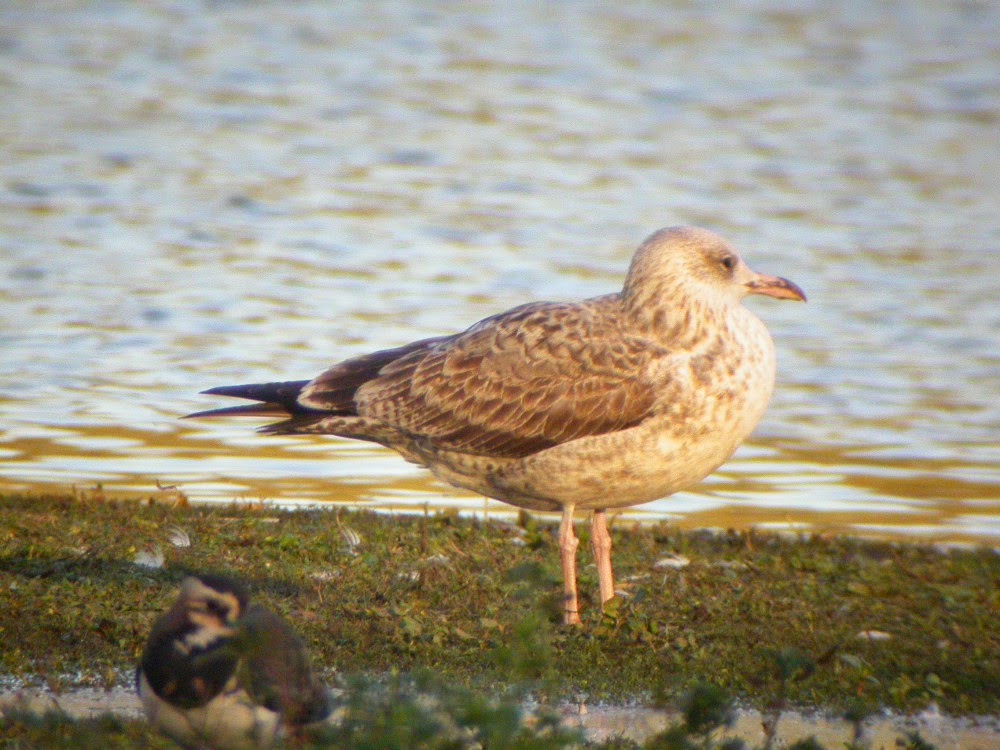
Gull numbers are still quite low, but should start to increase as there is now more space for them to gather.  Best birds recently have been a 2nd winter Yellow-legged Gull on the 18th:


Also this interesting intermedius/fuscus type LBBG:


It was on the back of the spit and fairly distant, but stood out due to:
1. Darkness of mantle
2. Still seemingly in summer plumage, with a clean white head
3. Daintiness and smaller size (look at the graellsii to the left) and domed shape to head

It didn't open its wings or move from the water whilst I was there, so I couldn't see its leg length or more importantly whether there was any contrast between the mantle and wing tip and whether the bird had started its primary moult yet.  A good indicator of fuscus is that it should not have started its primary moult, whereas graellsii and intermedius should have done.  However, there have been a few claims of fuscus in the country recently, so I wonder whether the northern range of intermedius might look like and behave more like fuscus.  It doesn't help this bird though, as I didn't see it well enough and haven't seen it since - hope it returns!

Monday, 6 October 2014

Quality wader

6th October - following a wet and windy morning, I took my lunch break just as the rain was beginning to subside.  I donned my wet weather gear and went to the pit to search for some 'good' birds.  I didn't see anything much on my first look from the west side other than a small flock of 12 Wigeon, which were new in.  I looked through the geese for possible wild ones, but only found the usual Bar-headed Goose, pretty, but not what I was after.  A look at the meadows revealed very little too, so I continued along the south bank to look at the east side of the spit.  There were 5 more Wigeon sitting on the water, so that made 17, a small influx, but there was nothing on the spit other than BHG and a couple of Herring Gulls.  I wandered back towards the car stopping to look at some vocal Goldcrests and a Chiffchaff and as I neared the viewpoint I took another look at the birds on the west side of the spit.  Almost immediately I clapped my eyes on an Avocet that was wading up and down the edge of the spit feeding away and seemingly catching quite a lot of tasty morsels.  This is a good wader for the site and represents about the 4th record (I think).  I wondered whether I had missed it amongst the BHG when I had arrived or whether it had flown in whilst I was in the meadow - it is surprising how they blend in amongst BHG.  I grabbed some record shots in the poor light and was thankful that it wasn't too far away, as it was constantly moving so difficult to get in focus.


Whilst watching the Avocet, a Water Rail flew past me along the bank towards the NW corner, which is my first of the autumn/winter.

Sunday, 5 October 2014

Owling

I've been a bit lax in posting of late, but there have been a few nice birds over the past 10 days.

Firstly, the patch has joined in in the bumper Stonechat passage seen recently, which is lovely to see, as Stonechats once quite easy to see in the county on passage and in the winter have been rather scarce over the past couple of years.  The hills to the north have had flocks of 19, 12 and 12 respectively, with other birds seen at other sites.  My patch had 3 birds on the 1st, when I found 2 males and a female type just to the north of Emmett's farm using a small patch of teasels and farm machinery to perch on.


A Yellow Wagtail over calling at the same time was nice.

On the 30th, a juvenile Peregrine was around the north side of the lake for a while and a couple of Ravens shared the same air space momentarily.  Snipe continue to climb in numbers, though are often hard to see on the overgrown spit, I often see them flying in from the south early in the day.  There were 11 on the 30th and 16 yesterday (4th) - hopefully a Jack will join them soon!  The only other waders seen during this period were 2 Green Sandpipers on the NE side of the spit on the 1st, though they flew into the works bay shortly after being seen.

Wildfowl have been thin on the ground so far this autumn.  Apart from the hundreds of Greylags, including several farmyard crosses and the lone Bar-headed Goose, a standard fixture during the winter months, Teal have been the most numerous of the scarcer ducks, but only between 10 and 20 so far; Shoveler have peaked at 10 on the 1st and just a single Wigeon on the 4th.  The usual pair of Black Swans are still ever present, which is not surprising, as they are pinioned.  I've no idea who placed them here, as they must have been by someone, but it has been suggested that they came from the manor house - they first appeared with a juvenile in the summer of 2013.


The male Firecrest continues to roam the area along the concrete road and is often seen near the crossroads with its Goldcrest friend.  I'm hoping that it stays to winter and can get onto my 2015 year list!  Otherwise, a late Willow Warbler on the 1st and a handful of Chiffchaffs are the only warblers I've seen.  There was a notable increase in Goldcrest numbers last week and there are calling birds all around the lake, certainly well into double figures of birds.

Last night, I finally visited the patch at dusk to add Barn Owl to the year list.  There have apparently been two pairs on site this summer, though I don't know how successful they have been.  When it was almost too dark to see, a bird screeched overhead and was joined by another near one of the nest boxes and I watched two white blobs wheeling about for a while until they both disappeared.

This morning, once the mist had cleared, the only interesting bird on the lake was a 1st winter Yellow-legged Gull that I watched flying in from the west.  It settled on the spit with the BHG flock and was one of only two LWHG on site.