9th September - I was working from home today and had seen a fairly steady fall of rain all morning, in fact by late morning it was raining pretty heavily. Wet weather often produces some interesting birds at the pit, so by early afternoon when the rain had lightened and was expected to pass through, I decided to take a late lunch and have a look.
On arrival, there was still a steady drizzle, so I birded with a big brolly over me in one hand and the scope handle in the other. There wasn't obviously anything new in, a juv Common Tern was patrolling the eastern side, the 2 Wigeon remained, Snipe numbered 3 on the western side of the spit and a Common Sand was probing the spit edge. The regular adult YL Gull was in and a male Gadwall was possibly new in as well. A Hobby flew over low and made a couple of assaults on the low flying Swallows and House Martins almost above my head before flying off east.
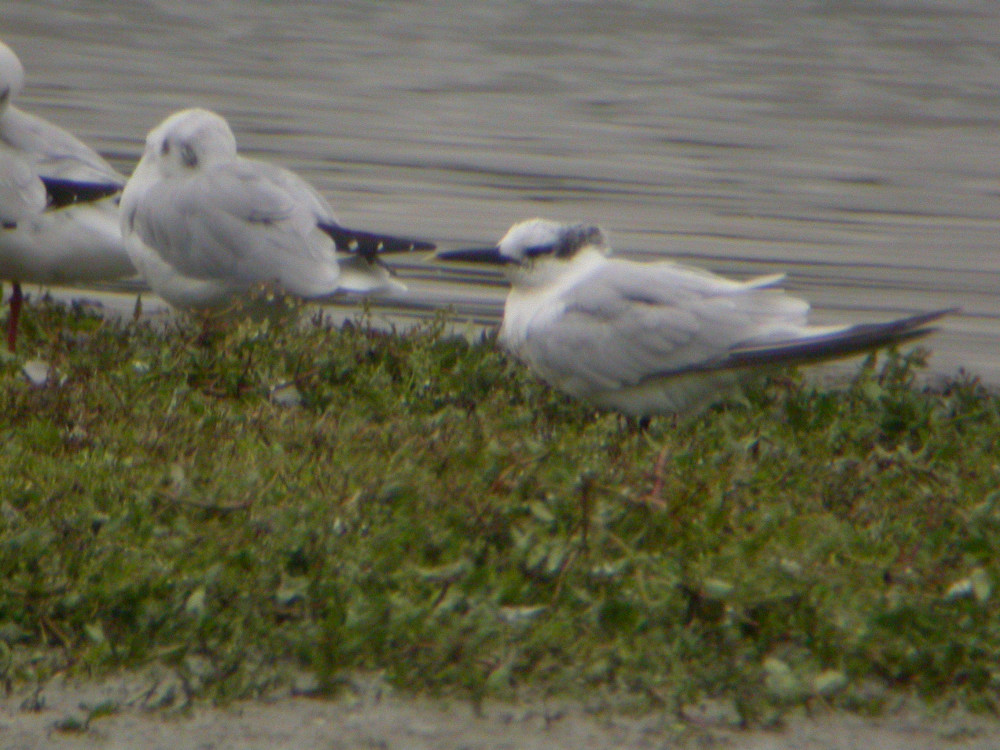
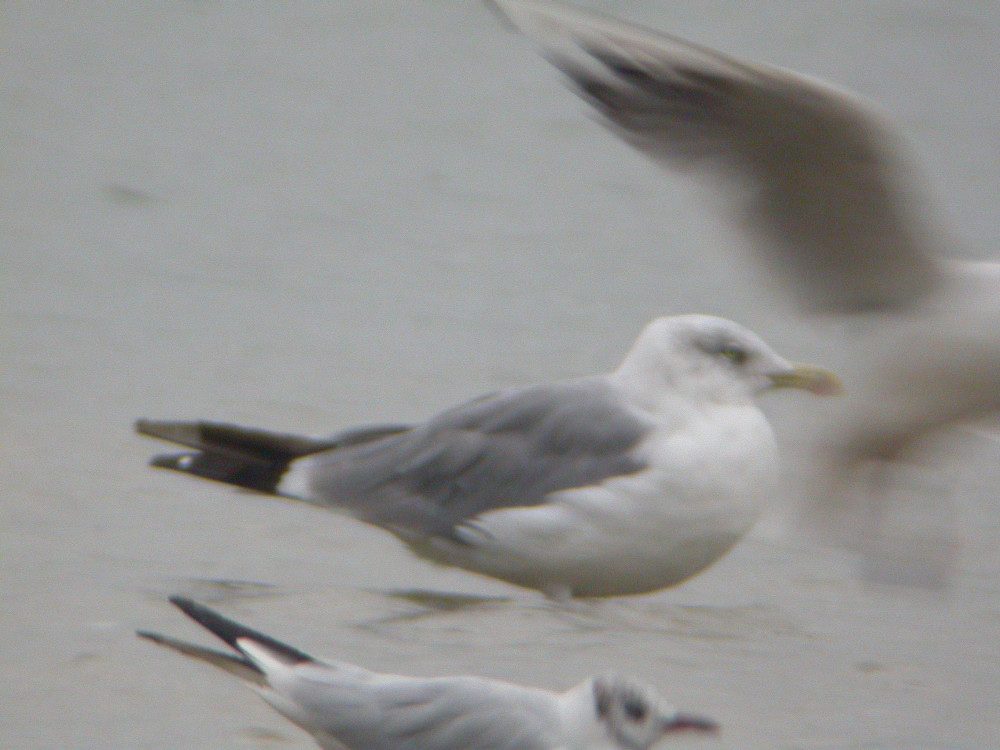
Shortly before 2pm, the rain subsided and I was able to put the brolly down. I was scrutinising the hirundines flying low in the NW arm when I heard a familiar harsh 'kirrick' call several times to the south of me. Knowing this was Sandwich Tern, I binned the end of the spit and saw 2 adult Sandwich Terns descend to the end of the spit - one was very white headed and in almost full winter plumage, the other had more black in the crest. I hurried over to the viewpoint to try and grab some record shots, but in the few seconds that it took to get there, they had taken off again. It was now obvious that there were actually 3 Sandwich Terns flying around and plunge diving off the end of the spit, as another very white headed winter plumaged adult was also present. They were flying very close to me and the yellow tipped bills were quite obvious as was the lack of any apparent juvenile plumage. I watched them for a few minutes until a Red Kite decided to fly fairly low over the spit putting up the BHG flock - the flock took off to the south taking the terns with them and I watched them fly low over the southern hedge presumably back to the Thames where they had probably come from in the first place. That was that I thought, but a few minutes later, one of the white headed birds returned and began to fly up and down the southern side of the lake. It plunge dived and caught a fairly large fish and then flew off to the eastern side where I lost it behind the island, before it returned and landed on the end of the spit. Here it remained for some time, preening and roosting enabling others to get a view as well. I took a few record shots of this bird:
I have now seen Sandwich Terns on 5 occasions at the pit and 3 of these have been when wet weather has been around, so obviously a good time to look for them.
Little Marlow GP is my local birding patch in South Bucks. This is a record of the birds seen during my regular visits. It includes record photos of many of my sightings, but I am not a photographer, so do not expect good quality images! Follow me on twitter: @Adamdbassett
Tuesday, 10 September 2013
Sunday, 8 September 2013
Ruff Justice
8th September - I cycled to the pit this afternoon with my daughter. Not long after we had arrived, a large black cloud rolled over and a heavy shower started which lasted a good 10 minutes or more. Fortunately the trees on the western bank gave pretty good cover, so we only got slightly damp. During and immediately after the rain stopping, no hoped for migrants had been forced down at all. We ventured to the pit edge to avoid the drips now falling from the trees and a scan around revealed 2 Wigeon as new arrivals, the continuing Common Sand, Snipe, adult YL Gull and juvenile Common Tern, which was calling frequently. The adult Dabchick was also in front of the spit and has been seen a couple of times recently, along with 3 Pochard, 3 Shoveler and 20+ Teal.
Whilst watching the now familiar party of 3 Black Swans swimming by, we were joined by Dave C and later Mick M and were lamenting the lack of new birds. Mick M had to leave and 10 minutes later I was about to leave as well when I saw a wader flying over fairly high to the east having come over the STW. Due to its size, I suspected a Ruff and looking through my bins confirmed this, the first Ruff I have seen here for 3 years. It flew around a couple of times and made two passes at the spit, looking as if to land, but each time it accelerated away, like a plane missing its landing spot. I think the large flock of gulls on the spit were putting it off. Eventually, it flew off high to the north and I watched it disappear, so unfortunately, no record shots, but it's nice to get another year tick at last - it's only been 5 weeks since the last one!
Monday, 2 September 2013
A new Juvenile Med Gull
September 1st - a late afternoon visit and there were plenty of gulls to look through. Best bird was a moulting juvenile Med Gull - a different looking bird to the regular one that has now not been seen for a couple of weeks. Record shots below:
Otherwise, just the regular adult winter YL Gull and a single regular Snipe of note.
First autumn Whinchat
Unfortunately not on the patch, but at the regular nearby site at Pump Lane paddocks. I noted my first returning Wheatear here on the 15th and Alan S had been seeing more Wheatears here whilst I was away towards the end of the month. On my return I found 2 more Wheatear on the 28th and then on 31st, 4 Wheatear, 2 Yellow Wagtails feeding around the horses and a single Whinchat
A nice end to a quiet month
August at the pit is usually pretty good for picking up waders, terns and passerine migrants, but this year has been very quiet and the worst in several years. I have had little time to visit over the past fortnight with work and family commitments, but the only reports from the site of any interest have been a flyover Greenshank and passage Spotted Flycatcher, so it doesn't look as though I've missed much!
August ended as it had begun with a couple of Black-tailed Godwits found on the 31st. I thought on first glance due to the overall pale buffy look to the birds that they were juveniles, however, on closer inspection, they appear to be moulting adults - one in almost full winter plumage with a few summer scaps and the other with more adult scaps, a more orange face and neck a few remnants of black barring on the undersides. A few record shots below:
August 31st also saw 3 Yellow-legged Gulls, the highest group this season, including my first juvenile, a fairly regular adult attaining winter plumage and another adult which quickly departed. The juvenile was readily picked out amongst other things due to its many moulted scaps, narrow pale fringed, dark centred tertials, pale face with a dark eye smudge and heavy, solid black bill. It was fairly distant, so my record shots are just that!
The visit on the 31st also included a Dunlin that was flying around for a while, but never landed and eventually departed to the SE. The resident Common Terns seem to have left now - birds are still being seen on and off in varying numbers, but these are probably migrants, especially as there are often several juvenile birds and we only managed 2 fledged young this year, both of which left a while ago. Today there was a single adult present. Ducks are also appearing in dribs and drabs - a couple of Shoveler, 8 Teal and 2 Pochard today, joining the building Tufted Ducks and resident Mallard.
On the passerine front, little to note. I did see a flurry of warblers mid month, including family groups of Reed Warblers, Garden Warbler, Blackcaps, Willow and Chiffchaff and on the 28th a nice Lesser Whitethroat feeding on Dogwood berries by the cottage gardens - this being only my second this year.
I don't usually mention Ring-necked parakeets, as they are seen or more usually heard fairly often. However, on the 14th, a bird was perched on a small oak near the cottages so I took this shot of it:
There was a noisy group of 7 birds flying around, including several short-tailed juveniles, so evidence of some local breeding.
On the plastic front, the family group of 3 Black Swans are still present and a Barnacle Goose has appeared along with the regular Bar-headed Goose amongst the ever growing Canada/Greylag flock.
August ended as it had begun with a couple of Black-tailed Godwits found on the 31st. I thought on first glance due to the overall pale buffy look to the birds that they were juveniles, however, on closer inspection, they appear to be moulting adults - one in almost full winter plumage with a few summer scaps and the other with more adult scaps, a more orange face and neck a few remnants of black barring on the undersides. A few record shots below:
August 31st also saw 3 Yellow-legged Gulls, the highest group this season, including my first juvenile, a fairly regular adult attaining winter plumage and another adult which quickly departed. The juvenile was readily picked out amongst other things due to its many moulted scaps, narrow pale fringed, dark centred tertials, pale face with a dark eye smudge and heavy, solid black bill. It was fairly distant, so my record shots are just that!
| This blurry record of the adult coming into winter plumage was taken on the 17th |
The visit on the 31st also included a Dunlin that was flying around for a while, but never landed and eventually departed to the SE. The resident Common Terns seem to have left now - birds are still being seen on and off in varying numbers, but these are probably migrants, especially as there are often several juvenile birds and we only managed 2 fledged young this year, both of which left a while ago. Today there was a single adult present. Ducks are also appearing in dribs and drabs - a couple of Shoveler, 8 Teal and 2 Pochard today, joining the building Tufted Ducks and resident Mallard.
On the passerine front, little to note. I did see a flurry of warblers mid month, including family groups of Reed Warblers, Garden Warbler, Blackcaps, Willow and Chiffchaff and on the 28th a nice Lesser Whitethroat feeding on Dogwood berries by the cottage gardens - this being only my second this year.
I don't usually mention Ring-necked parakeets, as they are seen or more usually heard fairly often. However, on the 14th, a bird was perched on a small oak near the cottages so I took this shot of it:
There was a noisy group of 7 birds flying around, including several short-tailed juveniles, so evidence of some local breeding.
On the plastic front, the family group of 3 Black Swans are still present and a Barnacle Goose has appeared along with the regular Bar-headed Goose amongst the ever growing Canada/Greylag flock.
Tuesday, 13 August 2013
Off Patch Birding
I haven't had much time to visit the patch over the past week with work and school holidays getting in the way. It doesn't look like I've missed much though apart from a brief flock of 6 Greenshank that Kevin H saw fly off west from the spit last Thursday (8th) - a large flock for this site. Hopefully 1 or 2 more will appear over the next few weeks. Whilst I'm thinking about 'missed' waders - I bumped into a guy that I didn't know last week who said that he'd had a flock of half a dozen Black-tailed Godwits on the spit. This was early on Sunday 28th July - he said that he watched them fly off south at around 6am - so you never know what else is going through unseen when we're all in bed!
The juvenile Med Gull is still being seen most days. It has started moulting its scaps now - I first noted this last Monday (5th) and took this record showing a nice pale grey scapular:
Today there was nothing unusual of note, but it was interesting to see at least 5 broods of Great Crested Grebes with recently hatched young - I saw broods of 4, 2, 2, 1 and 1+ (at least 1 hidden on the adult's back). They have hatched quite late, but obviously find the lake to their liking. A single winter plumaged Dabchick was also lurking under the island.
I have managed a couple of off patch visits recently. Firstly to see a nice adult Pec Sand at nearby Eton Wick, Berkshire on Sunday 4th. There was a juvenile at this exact same location last Autumn, so you could speculate that it is the same bird using the same route. The bird was keeping the company of 2 adult Dunlin, but refused to fly into Bucks as last year's bird did on several occasions.
Secondly, a visit to Tring Reservoirs, specifically Startops End Reservoir in mid Bucks. A 1st summer female Common Scoter had been showing well for several days, so I decided to take a look. This reservoir is a bit frustrating for county birders as the Herts/Bucks boundary runs through the NW part of it, most of it being in Herts, but the smaller NW side being in Bucks. If the bird is flying, such as last year's Sabine's Gull, then it can easily enter both counties, but a more sedentary bird such as last year's Snow Bunting can be more difficult. Luckily for me, the Common Scoter was in the NW corner on my arrival as that is where the loafing wildfowl flock was frequenting, so no waiting for it to swim into the 'correct' county.
And finally a couple of interesting non-avian garden records. I am lucky that I get Silver-washed Fritillary butterflies annually in the garden as a small breeding population frequents the adjacent woodland. Over the past week, a couple of females had been visiting the buddleia bushes and also ovipositing all over the place, including in the brickwork of the house under the damp course.
Striped Lychnis is a scarce national moth species, but Bucks is one of its strongholds. It was nice to find a distinctively marked Striped Lychnis caterpillar in the garden feeding on its foodplant, a verbascum sp.
The juvenile Med Gull is still being seen most days. It has started moulting its scaps now - I first noted this last Monday (5th) and took this record showing a nice pale grey scapular:
Today there was nothing unusual of note, but it was interesting to see at least 5 broods of Great Crested Grebes with recently hatched young - I saw broods of 4, 2, 2, 1 and 1+ (at least 1 hidden on the adult's back). They have hatched quite late, but obviously find the lake to their liking. A single winter plumaged Dabchick was also lurking under the island.
I have managed a couple of off patch visits recently. Firstly to see a nice adult Pec Sand at nearby Eton Wick, Berkshire on Sunday 4th. There was a juvenile at this exact same location last Autumn, so you could speculate that it is the same bird using the same route. The bird was keeping the company of 2 adult Dunlin, but refused to fly into Bucks as last year's bird did on several occasions.
Secondly, a visit to Tring Reservoirs, specifically Startops End Reservoir in mid Bucks. A 1st summer female Common Scoter had been showing well for several days, so I decided to take a look. This reservoir is a bit frustrating for county birders as the Herts/Bucks boundary runs through the NW part of it, most of it being in Herts, but the smaller NW side being in Bucks. If the bird is flying, such as last year's Sabine's Gull, then it can easily enter both counties, but a more sedentary bird such as last year's Snow Bunting can be more difficult. Luckily for me, the Common Scoter was in the NW corner on my arrival as that is where the loafing wildfowl flock was frequenting, so no waiting for it to swim into the 'correct' county.
And finally a couple of interesting non-avian garden records. I am lucky that I get Silver-washed Fritillary butterflies annually in the garden as a small breeding population frequents the adjacent woodland. Over the past week, a couple of females had been visiting the buddleia bushes and also ovipositing all over the place, including in the brickwork of the house under the damp course.
Sunday, 4 August 2013
Finally Get Blackwit
3rd August - I received a call from Alan S at midday to say that 3 Black-tailed Godwits had been reported at the pit - thanks Alan! I'd missed the last one a few weeks ago due to my phone not receiving texts for some unknown reason - also received a test from Malcolm P - thanks Malcolm! There have been lots of Blackwits around the region recently, so I was surprised there hadn't been more at the pit, as it normally does quite well for them. I made my way there with children in tow knowing that a work party was due out at 1pm and would probably disturb the birds. Fortunately the splendid 3 adult Black-tailed Godwits were still present, though slightly difficult to see in the southern bay. Often obscured by the near spit, the birds fed quite actively with the water up to their bellies at times. A few distant record shots below:
Otherwise, it was fairly quiet as it has been for a while.
A juvenile Med Gull has been very regular over the past week or so. I've seen it most times I've visited and it can be seen morning, daytime and evening, though it is usually only present for an hour or two at any of these times.
An adult YL Gull has also been regular over the past couple of weeks, though surprisingly for the time of year, this is the only one I've seen, except for a probable juvenile that I didn't have time to scrutinise properly.
I've continued to pass time by looking for CR gulls and have had repeat sightings of many of the BHG, though yellow 2BTS was a new one. This bird was ringed as an adult at Rainham tip in March this year.
A couple of recent ringed LBBG were also birds seen at this site in previous years - white WO (red) ringed in the Netherlands and black G:K, a regular bird for many years ringed in Bath in 2006 - it spends some of its summer here and winters in Portugal.
Otherwise, it was fairly quiet as it has been for a while.
A juvenile Med Gull has been very regular over the past week or so. I've seen it most times I've visited and it can be seen morning, daytime and evening, though it is usually only present for an hour or two at any of these times.
An adult YL Gull has also been regular over the past couple of weeks, though surprisingly for the time of year, this is the only one I've seen, except for a probable juvenile that I didn't have time to scrutinise properly.
I've continued to pass time by looking for CR gulls and have had repeat sightings of many of the BHG, though yellow 2BTS was a new one. This bird was ringed as an adult at Rainham tip in March this year.
A couple of recent ringed LBBG were also birds seen at this site in previous years - white WO (red) ringed in the Netherlands and black G:K, a regular bird for many years ringed in Bath in 2006 - it spends some of its summer here and winters in Portugal.
Subscribe to:
Posts (Atom)